One-to-Many
How a one-to-many relationship links many child rows to one parent row through a foreign key, like a customer and their orders.
Apprentice · SQL · Database · Updated
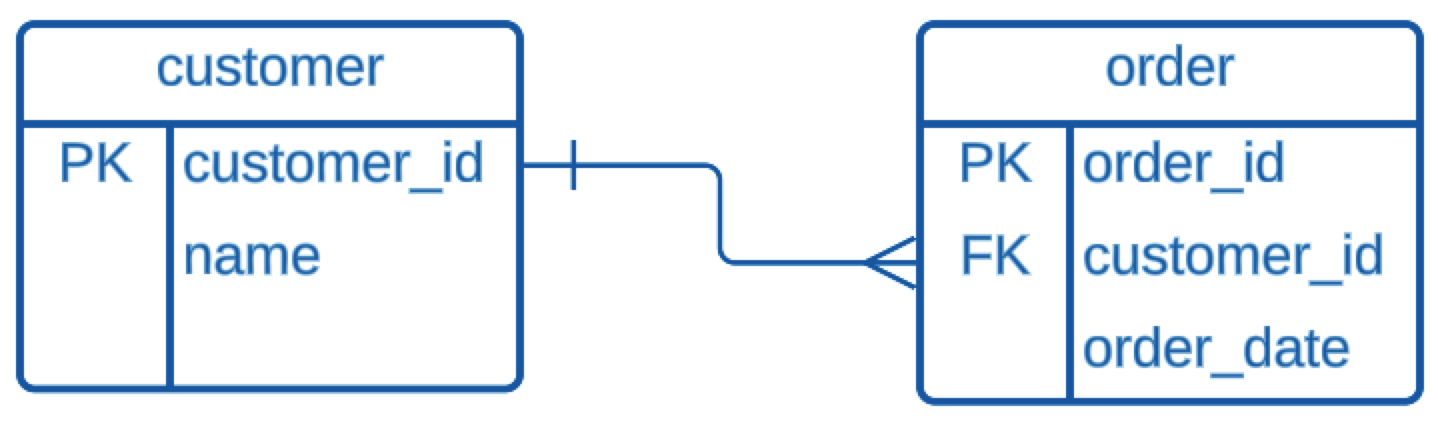
The One-to-Many relationship is the most common type of relationship in a database. In a One-to-Many relationship, a row in the parent table can be related to one or more rows in the child table. The relationship is created by having the foreign key in a child table refer to the primary key of the parent table.
For example, a customer can place many orders. The Customer table is the parent table and the Order table is the child.
Do it: find one customer's orders
Around the Horn has phoned to ask for a list of their orders. An order's row doesn't hold the customer's name: it holds the customer's CustomerId, a foreign key that points at the customer's row in Customers. One customer, many orders.
The two tables (the Tables tab shows the SQL that makes them):
Customers, the parent table:
| CustomerId | CompanyName |
|---|---|
| 1 | Alfreds Futterkiste |
| 2 | Around the Horn |
| 3 | Bon app' |
Orders, the child table. Its CustomerId is the foreign key:
| OrderId | CustomerId | OrderDate |
|---|---|---|
| 10248 | 1 | 2026-03-02 |
| 10249 | 2 | 2026-03-03 |
| 10250 | 3 | 2026-03-03 |
| 10251 | 2 | 2026-03-05 |
| 10252 | 1 | 2026-03-06 |
| 10253 | 2 | 2026-03-09 |
Working it through: in Customers, Around the Horn's CustomerId is 2. In Orders, the rows whose CustomerId is 2 are theirs. So your query should give exactly these rows, in this order:
| OrderId | OrderDate |
|---|---|
| 10249 | 2026-03-03 |
| 10251 | 2026-03-05 |
| 10253 | 2026-03-09 |
Your job: write one SELECT query on Orders that lists Around the Horn's orders.
- Show two columns,
OrderIdandOrderDate, in that order. - Keep only the rows whose
CustomerIdis Around the Horn's. - Sort them by
OrderId, smallest first.
Practiced live on the lesson page: write the SQL right there and check it.