Meet the Bakery App: Plan It, Build It
The first pass starts with a small app that works: a neighborhood bakery's ordering app, planned as a class diagram, built as version 1 in five languages, and then asked the question every pass starts with: what's likely to change?
Apprentice · OOP · Software Development · Updated
After this lesson you can
- Plan a small app's first version as a class diagram of its classes and how they connect
- Name the parts of an app most likely to change, and keep each one easy to find
Key takeaways
- Before writing code, name the things the app deals with (a cake, an order) and draw them as a class diagram: boxes for classes, arrows for how they connect.
- Version 1 only has to work. It doesn't need a single design pattern.
- The most useful planning question is "what's likely to change?": products, deals, who hears about an order, and the checkout steps will, while "an order has products and a total" won't.
- Every pattern in this pass comes from that list of changes, met one at a time, not from a catalog of patterns.
Every app you'll work on started small, and it worked. Then someone asked for a change, and another, and how the code handled the first few decided whether the tenth was easy or miserable. This pass follows one small app through that story: a neighborhood bakery's ordering app. This lesson plans it and builds version 1. The rest of the pass takes the owner's change requests one at a time.
What the app does
Sunrise Bakery sells three things: cakes ($30), boxes of six cupcakes ($12) and cookie boxes ($8). A customer picks what they want on a tablet at the counter, the app adds it up, and the receipt prints. That's all version 1 has to do.
Plan it: a class diagram first
Before any code, list the things the app deals with. They're nouns in the story: a cake, cupcakes, a cookie box, and an order that holds them. Each one becomes a class.
The three things for sale have something in common: each has a name and a price. So they all keep one promise, Product: "I can tell you my name and my price." In C#, Java and TypeScript that promise is an interface. Python and JavaScript have no interface keyword; any object with a name and a price will do.
A class diagram draws this as boxes and arrows. Each box is a class with its fields and methods. A dashed arrow with a hollow head means "keeps this promise", and a line from Order to Product means "an order holds products".
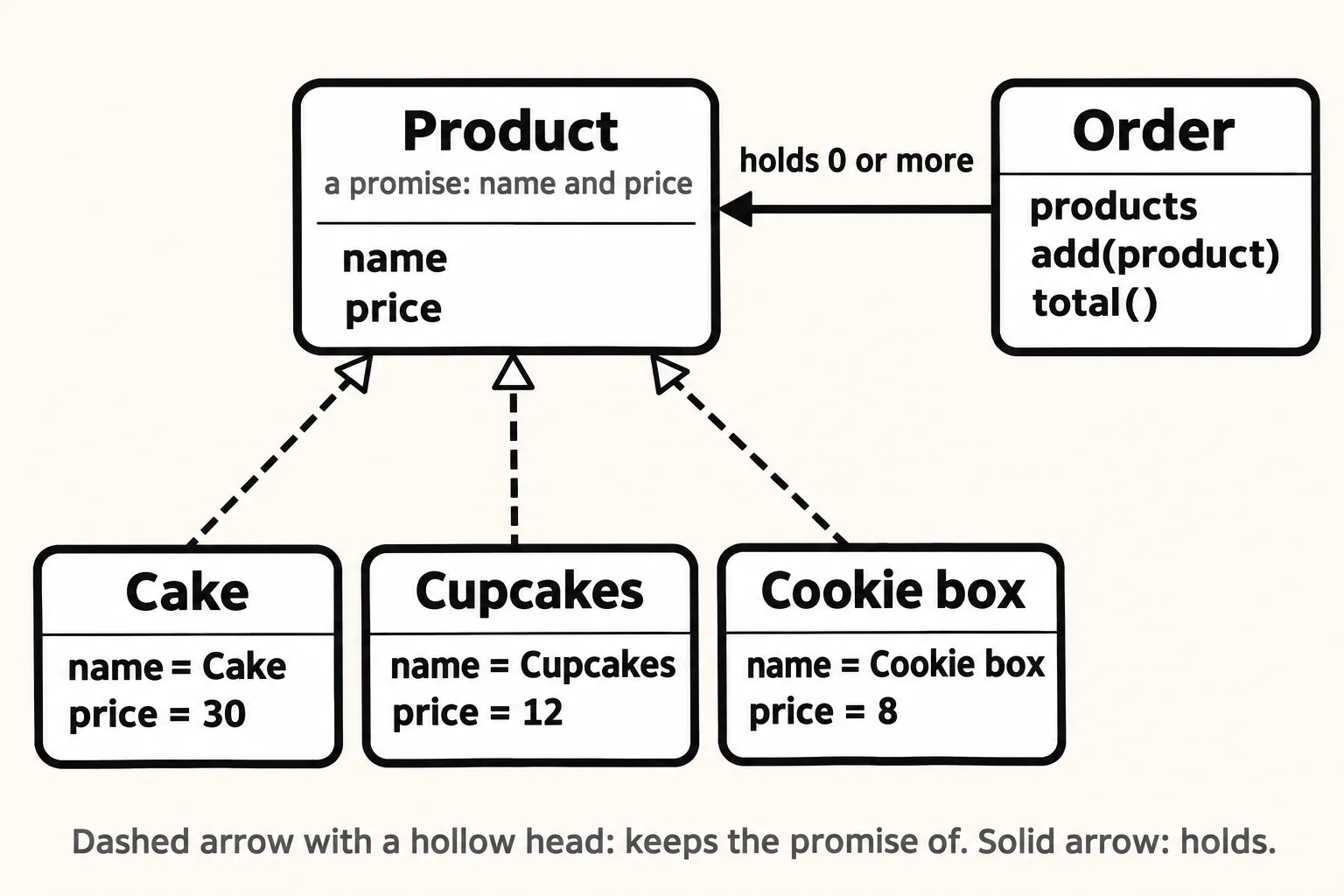
Drawing first takes five minutes and saves an hour. It shows what you're building, and it gives you words to ask the owner about before any code exists.
Build version 1
Here is the whole app. takeOrder gets what the customer tapped, as words like "cake", and turns each word into a product:
Order order = TakeOrder(new List<string> { "cake", "cupcakes", "cookies" });
foreach (IProduct product in order.Products)
{
Console.WriteLine(Cake: $30
Cupcakes: $12
Cookie box: $8
Total: $50
interface Product {
String name();
int price();
}
class Cake implements Product {
public String name() { return "Cake"; }
public int price() { return 30; }
}
class Cupcakes implements Product {
public String name() { return "Cupcakes"; }
public int price() { return 12; }
}
class CookieBox implements Product {
public String name() { return "Cookie box"; }
public int price() { return 8; }
}
class Order {
List<Product> products = new ArrayList<>();
void add(Product product) {
products.add(product);
}
int total() {
int total = 0;
for (Product product : products) {
total += product.price();
}
return total;
}
}
Order takeOrder(List<String> kinds) {
Order order = new Order();
for (String kind : kinds) {
if (kind.equals("cake")) {
order.add(new Cake());
} else if (kind.equals("cupcakes")) {
order.add(new Cupcakes());
} else if (kind.equals("cookies")) {
order.add(new CookieBox());
}
}
return order;
}
void main() {
Order order = takeOrder(List.of("cake", "cupcakes", "cookies"));
for (Product product : order.products) {
IO.println(product.name() + ": Cake: $30
Cupcakes: $12
Cookie box: $8
Total: $50
class Cake:
name = "Cake"
price = 30
class Cupcakes:
name = "Cupcakes"
price = 12
class CookieBox:
name = "Cookie box"
price = 8
class Order:
def __init__(self):
self.products = []
def add(self, product):
self.products.append(product)
def total(self):
total = 0
for product in self.products:
total += product.price
return total
def take_order(kinds):
order = Order()
for kind in kinds:
if kind == "cake":
order.add(Cake())
elif kind == "cupcakes":
order.add(Cupcakes())
elif kind == "cookies":
order.add(CookieBox())
return order
order = take_order(["cake", "cupcakes", "cookies"])
for product in order.products:
print(f"{product.name}: ${product.price}")
print(f"Total: ${order.total()}")
Cake: $30
Cupcakes: $12
Cookie box: $8
Total: $50
class Cake {
name = "Cake";
price = 30;
}
class Cupcakes {
name = "Cupcakes";
price = 12;
}
class CookieBox {
name = "Cookie box";
price = 8;
}
class Order {
products = [];
add(product) {
this.products.push(product);
}
total() {
let total = 0;
for (const product of this.products) {
total += product.price;
}
return total;
}
}
function takeOrder(kinds) {
const order = new Order();
for (const kind of kinds) {
if (kind === "cake") {
order.add(new Cake());
} else if (kind === "cupcakes") {
order.add(new Cupcakes());
} else if (kind === "cookies") {
order.add(new CookieBox());
}
}
return order;
}
const order = takeOrder(["cake", "cupcakes", "cookies"]);
for (const product of order.products) {
console.log(`${product.name}: ${product.price}`);
}
console.log(`Total: ${order.total()}`);
Cake: $30
Cupcakes: $12
Cookie box: $8
Total: $50
interface Product {
name: string;
price: number;
}
class Cake implements Product {
name = "Cake";
price = 30;
}
class Cupcakes implements Product {
name = "Cupcakes";
price = 12;
}
class CookieBox implements Product {
name = "Cookie box";
price = 8;
}
class Order {
products: Product[] = [];
add(product: Product): void {
this.products.push(product);
}
total(): number {
let total = 0;
for (const product of this.products) {
total += product.price;
}
return total;
}
}
function takeOrder(kinds: string[]): Order {
const order = new Order();
for (const kind of kinds) {
if (kind === "cake") {
order.add(new Cake());
} else if (kind === "cupcakes") {
order.add(new Cupcakes());
} else if (kind === "cookies") {
order.add(new CookieBox());
}
}
return order;
}
const order = takeOrder(["cake", "cupcakes", "cookies"]);
for (const product of order.products) {
console.log(`${product.name}: ${product.price}`);
}
console.log(`Total: ${order.total()}`);
Cake: $30
Cupcakes: $12
Cookie box: $8
Total: $50
It works, and that's the point of version 1. There isn't a design pattern in it, and it doesn't need one yet. Code that works and is easy to read is a fine place to start.
Try it. Add a second cake to the order and run it again. The total should be $80.
What's likely to change?
Here is the question every pass in this course starts with. Before the owner asks for anything, ask: which parts of this app are likely to change, and which aren't? You don't need to guess well. You need to ask the people who run the business, and listen.
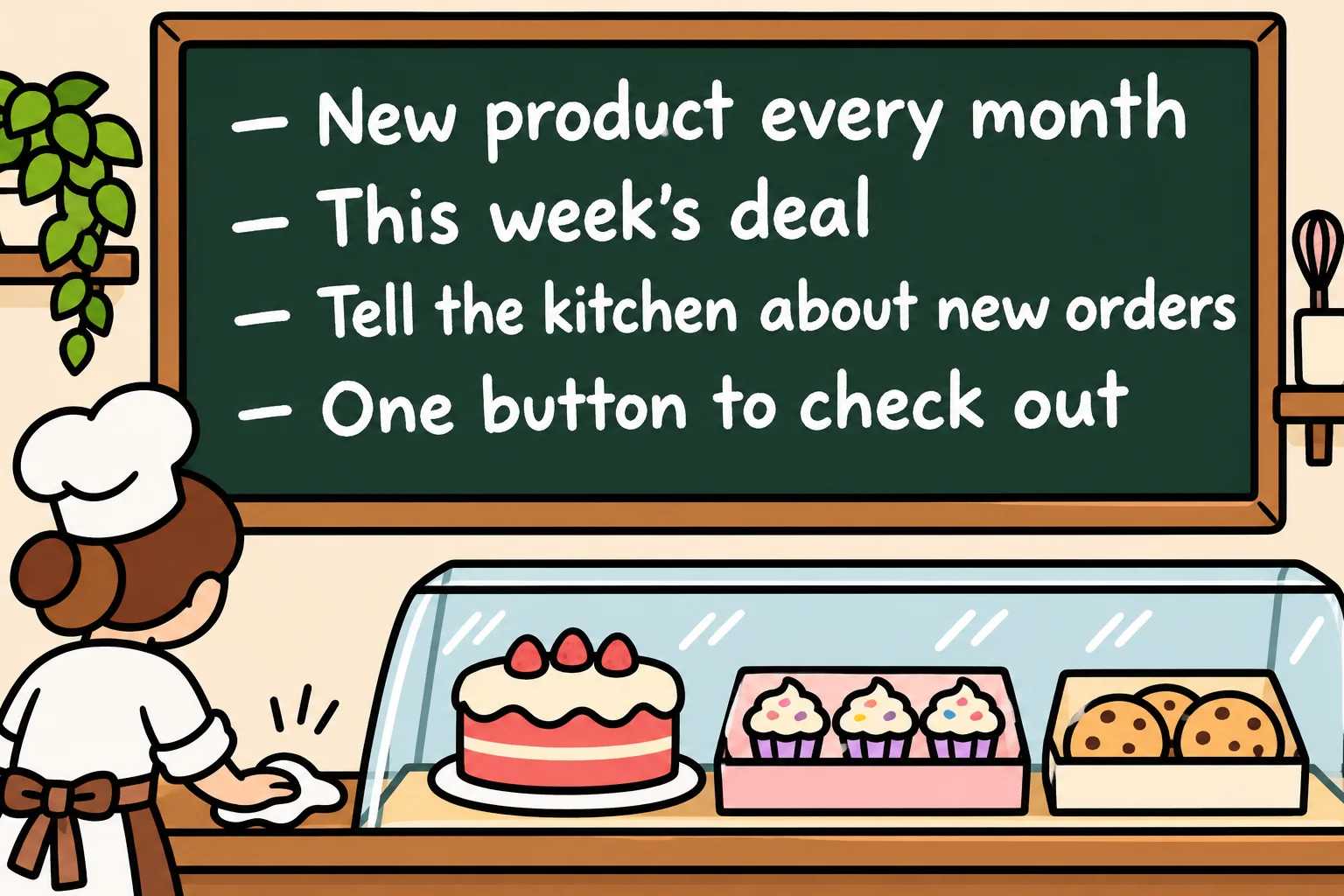
Sunrise Bakery's owner has a list already:
| Likely to change | Why | Where it lives in version 1 |
|---|---|---|
| The products | A new one every month: pies are next | the if chain in takeOrder |
| The deals | A new one every week | nowhere yet |
| Who hears about an order | The kitchen now, a delivery driver later | nowhere yet |
| The steps of checking out | Payment, stock, the receipt, the kitchen | nowhere yet |
And some things almost never change: an order holds products, and its total is their prices added up. Those parts can stay simple.
The parts that will change are the ones to keep easy to find, each in one place, so a change touches one spot instead of five. That's the idea behind encapsulation, applied to whole parts of an app: put each thing that changes behind its own wall, and the rest of the code doesn't have to care.
Where the patterns come from
Each row of that list will turn into a problem in this pass, and each problem into a fix that teams have found so often that it has a name: a design pattern. You'll meet the problem first, try the plain fixes, and learn the name last. That's the order it happened in real life: teams kept solving the same problems the same way, and someone wrote the solutions down.
The first row is first: pies arrive next month, and takeOrder is about to get a fourth else if.
Check yourself
2 questions to try on the lesson page.
So what
A class diagram and the question "what's likely to change?" are two of the most useful habits in software design, and they cost nothing but a few minutes before you write code. Every pass in this course starts with them.