Arrows: Is-a, Has-a and Uses
Boxes alone don't say how classes connect, so a class diagram joins them with four arrows (inherits, implements, has and uses), each with its own line and arrowhead, and each one read out loud as a sentence about the design.
Apprentice · Software Development · OOP · Updated
After this lesson you can
- Name the four arrows (inherits, implements, has, uses) by their line and arrowhead
- Read a class diagram out loud, and draw the arrow that a line of code means
Key takeaways
- Inherits (is a) is a solid line with a hollow triangle pointing at the parent class.
- Implements (keeps the promise of) is a dashed line with a hollow triangle pointing at the interface.
- Has (has a) is a solid line with an open arrowhead pointing at what's kept in a field; uses is a dashed one, for something only handed in for a moment.
- Every arrow points from the class that knows to the class it knows about, and every arrow reads out loud as one sentence.
Before this: Boxes: A Class on Paper, and Inheritance and Composition: Is-a and Has-a.
Priya now has a box for every class at the rental desk: Rentable, Bike, EBike, Scooter, CodeLock, Rental and Receipt. Seven boxes on a page, and she still can't answer the questions that matter. Is an e-bike a kind of bike, or does it carry one around? Does a rental keep its bike, or only look at it? If she changes Bike, what else changes with it?
Those answers are the design, and they live in how the classes connect. A class diagram draws each connection as an arrow, and there are four arrows in this course. Learn them once, and you can read the diagram of every pattern that follows.
The desk in code
Here is the desk, with one rental each for Maya, Sam and Dana. The receipt prints a line for a rental it's handed:
Rental[] rentals =
{
new Rental("Maya", new Bike("4821"), 2),
new Rental("Sam", new EBike("7310"), 3),
new Rental("Dana", new Scooter(), 1),
};
Receipt receipt = new Receipt();
foreach (Rental rental in rentals)
{
receipt.Print(rental);
}
interface IRentable
{
string Name { get; }
int Price(int hours);
}
class CodeLock
{
private string code;
public CodeLock(string code) { this.code = code; }
public bool Open(string tried) => tried == code;
}
class Bike : IRentable
{
private CodeLock codeLock;
public Bike(string lockCode) { codeLock = new CodeLock(lockCode); }
public virtual string Name => "Bike";
public virtual int Price(int hours) => 10 * hours;
}
class EBike : Bike
{
public EBike(string lockCode) : base(lockCode) { }
public override string Name => "E-bike";
public override int Price(int hours) => 15 * hours;
}
class Scooter : IRentable
{
public string Name => "Scooter";
public int Price(int hours) => 8 * hours;
}
class Rental
{
public string Rider { get; }
public IRentable Item { get; }
public int Hours { get; }
public Rental(string rider, IRentable item, int hours)
{
Rider = rider;
Item = item;
Hours = hours;
}
public int Total() => Item.Price(Hours);
}
class Receipt
{
public void Print(Rental rental)
{
Console.WriteLine(Maya: Bike, 2h, $20
Sam: E-bike, 3h, $45
Dana: Scooter, 1h, $8
interface Rentable {
String name();
int price(int hours);
}
class CodeLock {
private String code;
CodeLock(String code) { this.code = code; }
public boolean open(String tried) { return tried.equals(code); }
}
class Bike implements Rentable {
private CodeLock lock;
Bike(String lockCode) { lock = new CodeLock(lockCode); }
public String name() { return "Bike"; }
public int price(int hours) { return 10 * hours; }
}
class EBike extends Bike {
EBike(String lockCode) { super(lockCode); }
public String name() { return "E-bike"; }
public int price(int hours) { return 15 * hours; }
}
class Scooter implements Rentable {
public String name() { return "Scooter"; }
public int price(int hours) { return 8 * hours; }
}
class Rental {
String rider;
Rentable item;
int hours;
Rental(String rider, Rentable item, int hours) {
this.rider = rider;
this.item = item;
this.hours = hours;
}
public int total() { return item.price(hours); }
}
class Receipt {
public void print(Rental rental) {
IO.println(rental.rider + ": " + rental.item.name() + ", " + rental.hours + "h, Maya: Bike, 2h, $20
Sam: E-bike, 3h, $45
Dana: Scooter, 1h, $8
from abc import ABC, abstractmethod
class Rentable(ABC):
name = ""
@abstractmethod
def price(self, hours): ...
class CodeLock:
def __init__(self, code): self._code = code
def open(self, tried): return tried == self._code
class Bike(Rentable):
name = "Bike"
def __init__(self, lock_code): self._lock = CodeLock(lock_code)
def price(self, hours): return 10 * hours
class EBike(Bike):
name = "E-bike"
def price(self, hours): return 15 * hours
class Scooter(Rentable):
name = "Scooter"
def price(self, hours): return 8 * hours
class Rental:
def __init__(self, rider, item, hours):
self.rider = rider
self.item = item
self.hours = hours
def total(self):
return self.item.price(self.hours)
class Receipt:
def print(self, rental):
print(f"{rental.rider}: {rental.item.name}, {rental.hours}h, ${rental.total()}")
rentals = [
Rental("Maya", Bike("4821"), 2),
Rental("Sam", EBike("7310"), 3),
Rental("Dana", Scooter(), 1),
]
receipt = Receipt()
for rental in rentals:
receipt.print(rental)
Maya: Bike, 2h, $20
Sam: E-bike, 3h, $45
Dana: Scooter, 1h, $8
class CodeLock {
#code;
constructor(code) { this.#code = code; }
open(tried) { return tried === this.#code; }
}
class Bike {
name = "Bike";
#lock;
constructor(lockCode) { this.#lock = new CodeLock(lockCode); }
price(hours) { return 10 * hours; }
}
class EBike extends Bike {
name = "E-bike";
price(hours) { return 15 * hours; }
}
class Scooter {
name = "Scooter";
price(hours) { return 8 * hours; }
}
class Rental {
constructor(rider, item, hours) {
this.rider = rider;
this.item = item;
this.hours = hours;
}
total() { return this.item.price(this.hours); }
}
class Receipt {
print(rental) {
console.log(`${rental.rider}: ${rental.item.name}, ${rental.hours}h, ${rental.total()}`);
}
}
const rentals = [
new Rental("Maya", new Bike("4821"), 2),
new Rental("Sam", new EBike("7310"), 3),
new Rental("Dana", new Scooter(), 1),
];
const receipt = new Receipt();
for (const rental of rentals) {
receipt.print(rental);
}
Maya: Bike, 2h, $20
Sam: E-bike, 3h, $45
Dana: Scooter, 1h, $8
interface Rentable {
name: string;
price(hours: number): number;
}
class CodeLock {
private code: string;
constructor(code: string) { this.code = code; }
open(tried: string): boolean { return tried === this.code; }
}
class Bike implements Rentable {
name = "Bike";
private lock: CodeLock;
constructor(lockCode: string) { this.lock = new CodeLock(lockCode); }
price(hours: number): number { return 10 * hours; }
}
class EBike extends Bike {
name = "E-bike";
price(hours: number): number { return 15 * hours; }
}
class Scooter implements Rentable {
name = "Scooter";
price(hours: number): number { return 8 * hours; }
}
class Rental {
rider: string;
item: Rentable;
hours: number;
constructor(rider: string, item: Rentable, hours: number) {
this.rider = rider;
this.item = item;
this.hours = hours;
}
total(): number { return this.item.price(this.hours); }
}
class Receipt {
print(rental: Rental): void {
console.log(`${rental.rider}: ${rental.item.name}, ${rental.hours}h, ${rental.total()}`);
}
}
const rentals = [
new Rental("Maya", new Bike("4821"), 2),
new Rental("Sam", new EBike("7310"), 3),
new Rental("Dana", new Scooter(), 1),
];
const receipt = new Receipt();
for (const rental of rentals) {
receipt.print(rental);
}
Maya: Bike, 2h, $20
Sam: E-bike, 3h, $45
Dana: Scooter, 1h, $8
The promise is written differently in each language: an interface in C# (named IRentable, since C# names interfaces with an I in front), Java and TypeScript; an abstract base class in Python; and nothing at all in JavaScript, where any object with a name and a price will do. The diagram draws all five the same way. (As in the last lesson, the TypeScript lock is CodeLock, since the browser's types already have a CodeLock.)
Four arrows, four sentences
Every line of that code that connects two classes is one of four kinds:
| Arrow | The line | The head | Read it as | In the code |
|---|---|---|---|---|
| Inherits | solid | hollow triangle, at the parent | "is a" | class EBike : Bike, extends Bike, class EBike(Bike) |
| Implements | dashed | hollow triangle, at the interface | "keeps the promise of" | class Bike : IRentable, implements Rentable |
| Has | solid | open arrowhead (a plain V), at the part | "has a" | a field: private CodeLock codeLock |
| Uses | dashed | open arrowhead, at what's used | "uses" | a parameter or a local variable: Print(Rental rental) |
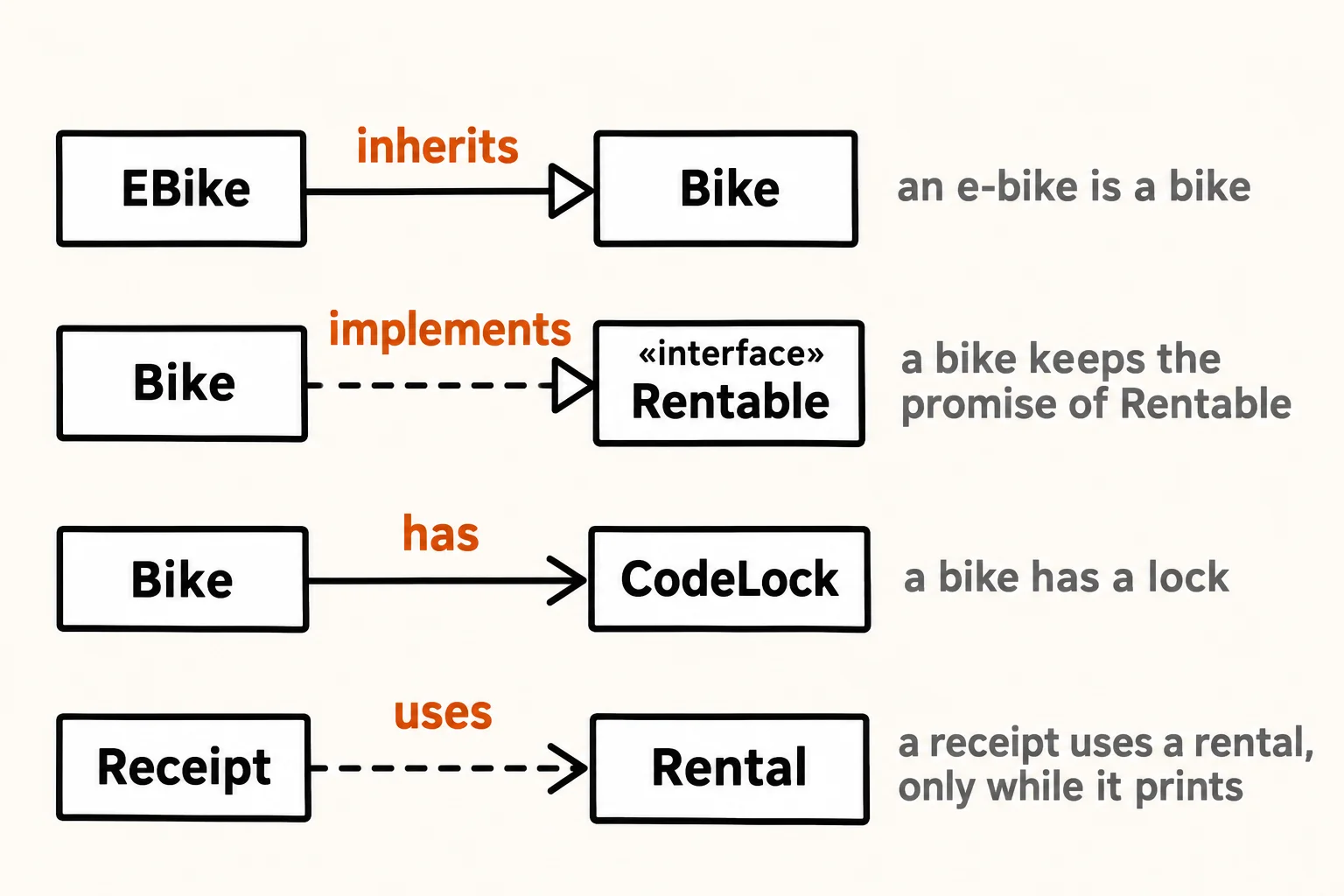
Two pairs make them easy to remember. A triangle means "a kind of": the class is a kind of its parent, or a kind of thing that keeps the promise. A dashed line means "lighter": implementing a promise is lighter than inheriting a whole class, and using something for a moment is lighter than keeping it.
The difference between has and uses is where the other object lives. A Bike keeps its lock in a field for its whole life: it has one. A Receipt is handed a rental, prints a line and forgets it: it only uses one. In the textbook UML words, has is an association, and uses is a dependency.
Which way the arrow points
Every arrow points from the class that knows to the class it knows about. Bike's code mentions Rentable; Rentable's code never mentions Bike. So the arrow starts at Bike. That's worth knowing when you change things: change the class at the arrowhead, and every class at the other end of its arrows may need a look.
The whole desk, read out loud
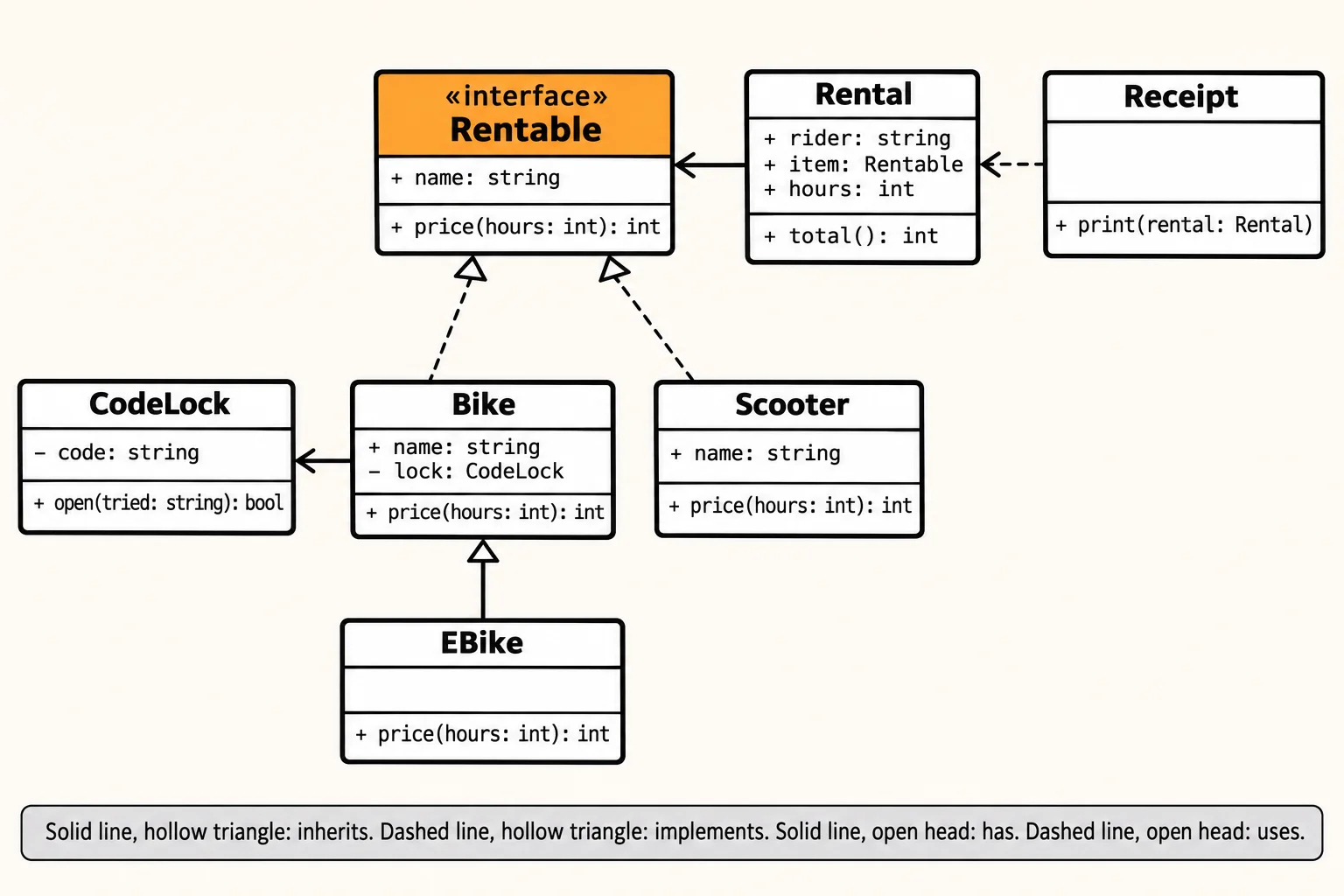
Read each arrow as its sentence, and you have the design in six lines:
- An e-bike is a bike.
- A bike keeps the Rentable promise, and so does a scooter.
- A bike has a lock.
- A rental has a rentable.
- A receipt uses a rental.
Notice what there's no arrow for: EBike to Rentable. An e-bike already keeps the promise, because it's a bike; the diagram doesn't repeat it. And Rental points at Rentable, not at Bike: a rental can hold anything that keeps the promise, which is why Dana's scooter fit without a change. You can see that in one glance at the diagram, and it would take a careful read of the code.
Try it. Sam adds a Helmet class, and Bike gets a field that holds one. Which arrow do you draw, from where to where? (A solid line with an open arrowhead, from Bike to Helmet: a bike has a helmet.)
Check yourself
2 questions to try on the lesson page.
So what
Four arrows turn a page of boxes into a design you can read aloud, and check against the code. Next: how many of each, and who owns what.