Interpreter: A Little Language for Rules
When business rules change every week and live in code as one if per rule, every new rule waits for a developer; the Interpreter pattern turns each rule into a tree of small pieces (a check, an and, an or, a not) that each answer one question, so a new rule is data, not code.
Freelancer · OOP · Updated
After this lesson you can
- Build a rule as a tree of small pieces that each answer one question, joined by and, or and not
- Spot the smells that point to Interpreter: rules that change often, hard-coded as one if per rule
- Choose between plain code, a rule tree and a parser library for rules users write, and say why
Key takeaways
- The smell: one if per rule, in code, for rules that change every week and belong to someone who isn't a developer.
- The cause: the rules are really data, but they're stored as code, so only a developer can add one.
- The fix: a few small pieces (checks, and, or, not), each answering "does this order qualify?", snapped together into a tree.
- The same tree can be built from functions; when users type a whole language as text, a parser library builds the tree.
Before this: Composite: Boxes Inside Boxes (a tree where a box and a pallet answer the same question), interfaces, and passing a function as a value.
Trailhead Outfitters sells hiking gear online, and its marketing team runs a new coupon almost every week. Today every coupon is a ticket for a developer, who writes an if, tests it and waits for the next release. Marketing wants an admin screen where they build rules themselves: pick "total over", type 50, pick "and", pick "has a", choose "shoe", in shapes nobody has thought of yet. By the end of this lesson you'll have built the tiny language that screen needs, and met the pattern behind it, Interpreter.
The symptom: a new if for every coupon
The store sells four products: hiking boots ($120, a shoe), a rain jacket ($80), a water bottle ($15) and trail socks ($12). Here are this week's coupons and three customers' orders:
Product boots = new Product("Hiking boots", 120, "shoe");
Product jacket = new Product("Rain jacket", 80, "jacket");
Product bottle = new Product("Water bottle", 15, "bottle");
Product socks = new Product("Trail socks", 12, "socks");
List<Order> orders = new List<Order>
{
new Order("Maya", new List<Product> { boots, socks }),
new Order("Sam", new List<Product> { jacket }),
new Order("Leo", new List<Product> { bottle, socks }),
};
// Marketing wrote BOOTS20 on Monday: "has a shoe and total over $100".
List<string> coupons = new List<string> { "TRAIL10", "BOTTLE", "BOOTS20" };
foreach (Order order in orders)
{
List<string> codes = coupons.Where(code => Qualifies(code, order)).ToList();
Console.WriteLine(Maya ($132): TRAIL10
Sam ($80): TRAIL10, BOTTLE
Leo ($27): none
record Product(String name, int price, String kind) {}
record Order(String customer, List<Product> products) {
int total() { return products.stream().mapToInt(Product::price).sum(); }
boolean has(String kind) { return products.stream().anyMatch(product -> product.kind().equals(kind)); }
}
boolean qualifies(String code, Order order) {
if (code.equals("TRAIL10")) { return order.total() > 50 && (order.has("shoe") || order.has("jacket")); }
if (code.equals("BOTTLE")) { return order.has("jacket") && !order.has("bottle"); }
return false;
}
void main() {
Product boots = new Product("Hiking boots", 120, "shoe");
Product jacket = new Product("Rain jacket", 80, "jacket");
Product bottle = new Product("Water bottle", 15, "bottle");
Product socks = new Product("Trail socks", 12, "socks");
List<Order> orders = List.of(
new Order("Maya", List.of(boots, socks)),
new Order("Sam", List.of(jacket)),
new Order("Leo", List.of(bottle, socks)));
// Marketing wrote BOOTS20 on Monday: "has a shoe and total over $100".
List<String> coupons = List.of("TRAIL10", "BOTTLE", "BOOTS20");
for (Order order : orders) {
List<String> codes = coupons.stream().filter(code -> qualifies(code, order)).toList();
IO.println(order.customer() + " (Maya ($132): TRAIL10
Sam ($80): TRAIL10, BOTTLE
Leo ($27): none
class Product:
def __init__(self, name, price, kind):
self.name = name
self.price = price
self.kind = kind
class Order:
def __init__(self, customer, products):
self.customer = customer
self.products = products
def total(self):
return sum(product.price for product in self.products)
def has(self, kind):
return any(product.kind == kind for product in self.products)
def qualifies(code, order):
if code == "TRAIL10":
return order.total() > 50 and (order.has("shoe") or order.has("jacket"))
if code == "BOTTLE":
return order.has("jacket") and not order.has("bottle")
return False
boots = Product("Hiking boots", 120, "shoe")
jacket = Product("Rain jacket", 80, "jacket")
bottle = Product("Water bottle", 15, "bottle")
socks = Product("Trail socks", 12, "socks")
orders = [Order("Maya", [boots, socks]), Order("Sam", [jacket]), Order("Leo", [bottle, socks])]
# Marketing wrote BOOTS20 on Monday: "has a shoe and total over $100".
coupons = ["TRAIL10", "BOTTLE", "BOOTS20"]
for order in orders:
codes = [code for code in coupons if qualifies(code, order)]
print(f"{order.customer} (${order.total()}): {', '.join(codes) or 'none'}")
Maya ($132): TRAIL10
Sam ($80): TRAIL10, BOTTLE
Leo ($27): none
class Product {
constructor(name, price, kind) {
this.name = name;
this.price = price;
this.kind = kind;
}
}
class Order {
constructor(customer, products) {
this.customer = customer;
this.products = products;
}
total() { return this.products.reduce((sum, product) => sum + product.price, 0); }
has(kind) { return this.products.some((product) => product.kind === kind); }
}
function qualifies(code, order) {
if (code === "TRAIL10") { return order.total() > 50 && (order.has("shoe") || order.has("jacket")); }
if (code === "BOTTLE") { return order.has("jacket") && !order.has("bottle"); }
return false;
}
const boots = new Product("Hiking boots", 120, "shoe");
const jacket = new Product("Rain jacket", 80, "jacket");
const bottle = new Product("Water bottle", 15, "bottle");
const socks = new Product("Trail socks", 12, "socks");
const orders = [new Order("Maya", [boots, socks]), new Order("Sam", [jacket]), new Order("Leo", [bottle, socks])];
// Marketing wrote BOOTS20 on Monday: "has a shoe and total over $100".
const coupons = ["TRAIL10", "BOTTLE", "BOOTS20"];
for (const order of orders) {
const codes = coupons.filter((code) => qualifies(code, order));
console.log(`${order.customer} (${order.total()}): ${codes.join(", ") || "none"}`);
}
Maya ($132): TRAIL10
Sam ($80): TRAIL10, BOTTLE
Leo ($27): none
class Product {
name: string;
price: number;
kind: string;
constructor(name: string, price: number, kind: string) {
this.name = name;
this.price = price;
this.kind = kind;
}
}
class Order {
customer: string;
products: Product[];
constructor(customer: string, products: Product[]) {
this.customer = customer;
this.products = products;
}
total(): number { return this.products.reduce((sum, product) => sum + product.price, 0); }
has(kind: string): boolean { return this.products.some((product) => product.kind === kind); }
}
function qualifies(code: string, order: Order): boolean {
if (code === "TRAIL10") { return order.total() > 50 && (order.has("shoe") || order.has("jacket")); }
if (code === "BOTTLE") { return order.has("jacket") && !order.has("bottle"); }
return false;
}
const boots = new Product("Hiking boots", 120, "shoe");
const jacket = new Product("Rain jacket", 80, "jacket");
const bottle = new Product("Water bottle", 15, "bottle");
const socks = new Product("Trail socks", 12, "socks");
const orders = [new Order("Maya", [boots, socks]), new Order("Sam", [jacket]), new Order("Leo", [bottle, socks])];
// Marketing wrote BOOTS20 on Monday: "has a shoe and total over $100".
const coupons = ["TRAIL10", "BOTTLE", "BOOTS20"];
for (const order of orders) {
const codes = coupons.filter((code) => qualifies(code, order));
console.log(`${order.customer} (${order.total()}): ${codes.join(", ") || "none"}`);
}
Maya ($132): TRAIL10
Sam ($80): TRAIL10, BOTTLE
Leo ($27): none
Maya's order has a shoe and costs $132, so BOOTS20 ("has a shoe and total over $100") should apply. It doesn't. Marketing added it to the list on Monday, but qualifies has never heard of it, so it quietly says no. Making it work means a developer adding a third if. Next week, a fourth.
Read it as a doctor would:
- The symptom: one
ifper rule, in code, growing every week, for rules a developer doesn't own. - The cause: the rules are really data. They change often, and someone else writes them. But they live in code, so only a developer can add one, and every mix of "and", "or" and "not" is written by hand.
- The cure: coming up, once we've tried the obvious fixes.
What would you try?
One more if per coupon. It makes BOOTS20 work today. But every coupon still waits for a developer and a release, and marketing's list and the code drift apart, as they did on Monday.
A table with a column for each check: a minimum total, "needs a shoe", "needs a jacket". Marketing can fill in rows themselves, but a row only says "this and this and this". "A shoe or a jacket" and "not a bottle" each need a new column, and the table grows rules of its own.
Run marketing's text as code, with eval in Python or JavaScript. It runs anything anyone types, including code that empties the database, and a typo shows marketing a Python error.
What we want is a handful of pieces that snap together in any shape: a few checks ("total over", "has a") and a few joins ("and", "or", "not"). Then code that can answer "does this order qualify?" for any shape marketing builds.
The everyday version: a recipe card's shorthand
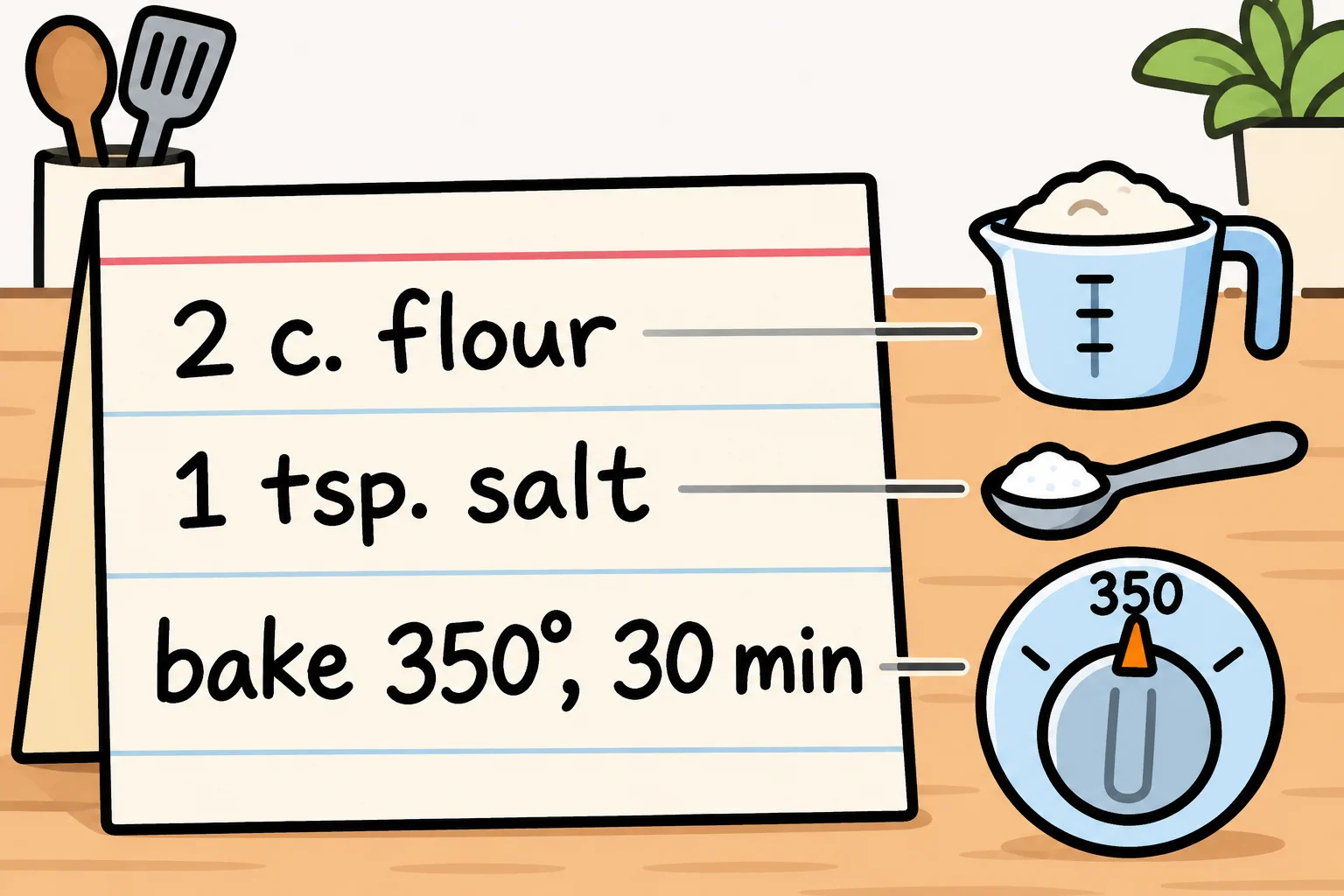
A kitchen already has a little language. A recipe card says "2 c. flour, 1 tsp. salt, bake 350°, 30 min", and every cook can read it, even a card written tomorrow by someone they've never met. Each piece of shorthand means one thing ("c." is a cup, "350°" is the oven's dial), and the pieces combine into any recipe. A new recipe doesn't need a new cook, only a new card.
The fix: a rule is a tree of small pieces
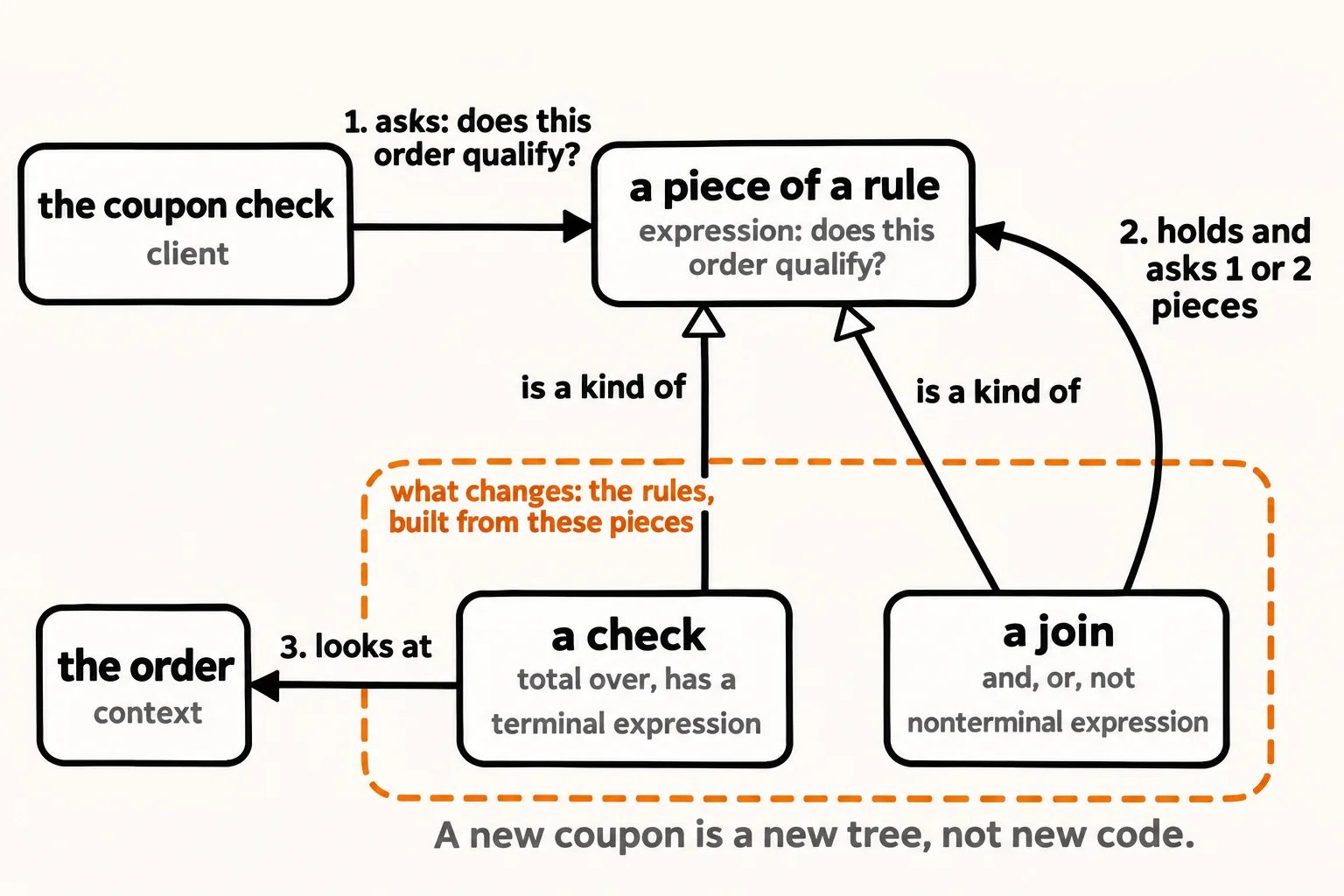
The fix in one sentence: each piece of a rule becomes a small object that answers "does this order qualify?"; a check answers by looking at the order, and a join answers by asking the pieces it holds.
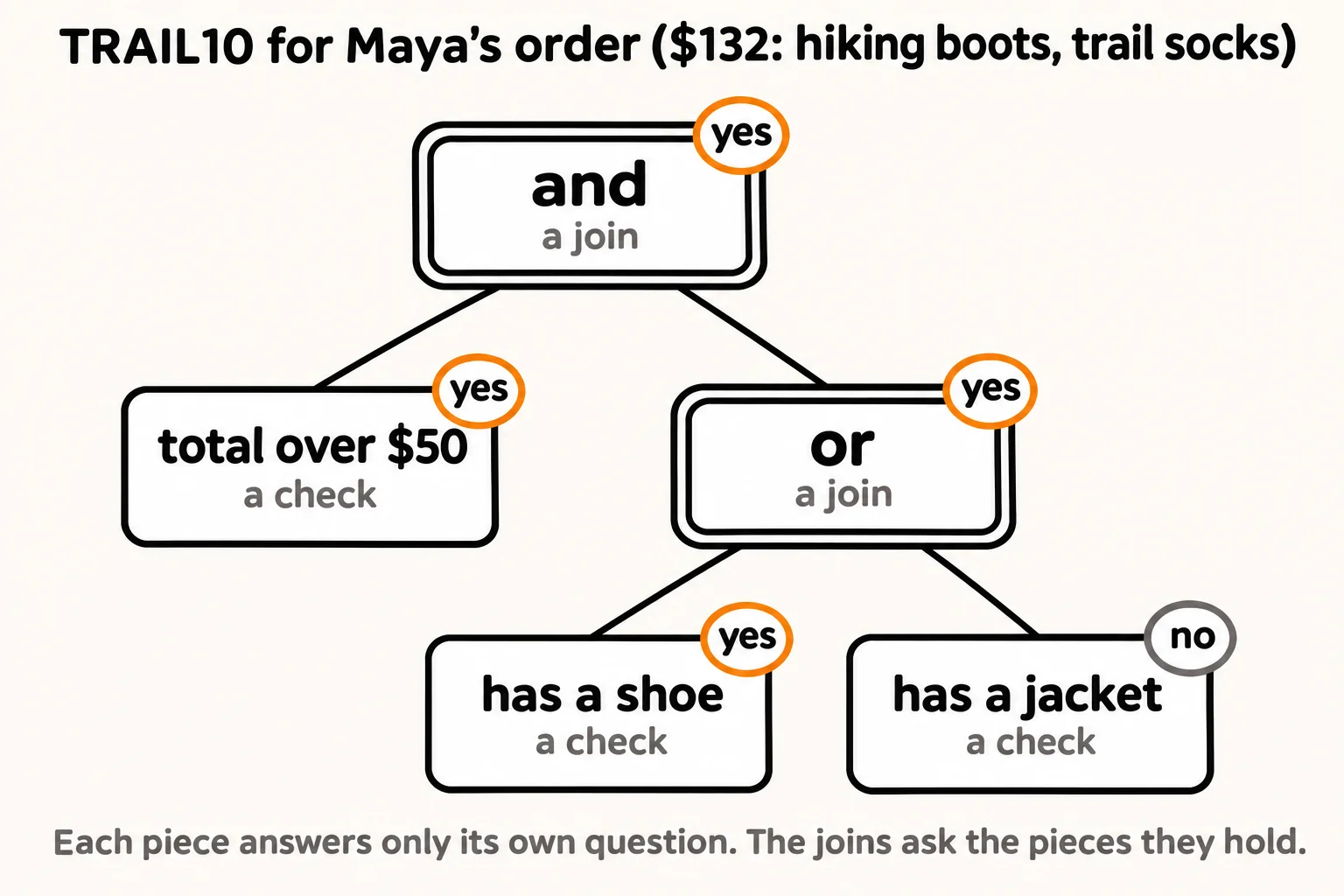
Here is TRAIL10, "total over $50 and (has a shoe or has a jacket)", as a tree. To answer for Maya's order, the "and" at the top asks its two pieces. "Total over $50" looks at the total: yes. The "or" asks its own two pieces: "has a shoe" says yes, "has a jacket" says no, so the "or" says yes. Both of the "and"'s pieces said yes, so TRAIL10 applies. No piece knows anything about the others; each answers only its own question.
Drawn as roles, there are only two kinds of piece, and the fence goes around what marketing changes:
Here is the same program with the rules as trees:
Product boots = new Product("Hiking boots", 120, "shoe");
Product jacket = new Product("Rain jacket", 80, "jacket");
Product bottle = new Product("Water bottle", 15, "bottle");
Product socks = new Product("Trail socks", 12, "socks");
List<Order> orders = new List<Order>
{
new Order("Maya", new List<Product> { boots, socks }),
new Order("Sam", new List<Product> { jacket }),
new Order("Leo", new List<Product> { bottle, socks }),
};
// Each rule is a tree of small pieces. The admin screen builds these from marketing's choices.
Dictionary<string, IRule> rules = new Dictionary<string, IRule>
{
["TRAIL10"] = new And(new TotalOver(50), new Or(new Has("shoe"), new Has("jacket"))),
["BOTTLE"] = new And(new Has("jacket"), new Not(new Has("bottle"))),
["BOOTS20"] = new And(new Has("shoe"), new TotalOver(100)),
};
foreach (Order order in orders)
{
List<string> codes = rules.Where(rule => rule.Value.Qualifies(order)).Select(rule => rule.Key).ToList();
Console.WriteLine(Maya ($132): TRAIL10, BOOTS20
Sam ($80): TRAIL10, BOTTLE
Leo ($27): none
record Product(String name, int price, String kind) {}
record Order(String customer, List<Product> products) {
int total() { return products.stream().mapToInt(Product::price).sum(); }
boolean has(String kind) { return products.stream().anyMatch(product -> product.kind().equals(kind)); }
}
// Every piece of a rule answers one question.
interface Rule { boolean qualifies(Order order); }
// The leaves: each checks one thing about the order.
record TotalOver(int amount) implements Rule { public boolean qualifies(Order order) { return order.total() > amount; } }
record Has(String kind) implements Rule { public boolean qualifies(Order order) { return order.has(kind); } }
// The joins: each holds other pieces and asks them.
record And(Rule left, Rule right) implements Rule { public boolean qualifies(Order order) { return left.qualifies(order) && right.qualifies(order); } }
record Or(Rule left, Rule right) implements Rule { public boolean qualifies(Order order) { return left.qualifies(order) || right.qualifies(order); } }
record Not(Rule rule) implements Rule { public boolean qualifies(Order order) { return !rule.qualifies(order); } }
void main() {
Product boots = new Product("Hiking boots", 120, "shoe");
Product jacket = new Product("Rain jacket", 80, "jacket");
Product bottle = new Product("Water bottle", 15, "bottle");
Product socks = new Product("Trail socks", 12, "socks");
List<Order> orders = List.of(
new Order("Maya", List.of(boots, socks)),
new Order("Sam", List.of(jacket)),
new Order("Leo", List.of(bottle, socks)));
// Each rule is a tree of small pieces. The admin screen builds these from marketing's choices.
Map<String, Rule> rules = new LinkedHashMap<>();
rules.put("TRAIL10", new And(new TotalOver(50), new Or(new Has("shoe"), new Has("jacket"))));
rules.put("BOTTLE", new And(new Has("jacket"), new Not(new Has("bottle"))));
rules.put("BOOTS20", new And(new Has("shoe"), new TotalOver(100)));
for (Order order : orders) {
List<String> codes = rules.keySet().stream().filter(code -> rules.get(code).qualifies(order)).toList();
IO.println(order.customer() + " (Maya ($132): TRAIL10, BOOTS20
Sam ($80): TRAIL10, BOTTLE
Leo ($27): none
class Product:
def __init__(self, name, price, kind):
self.name = name
self.price = price
self.kind = kind
class Order:
def __init__(self, customer, products):
self.customer = customer
self.products = products
def total(self):
return sum(product.price for product in self.products)
def has(self, kind):
return any(product.kind == kind for product in self.products)
# Every piece of a rule answers one question: qualifies(order).
# The leaves: each checks one thing about the order.
class TotalOver:
def __init__(self, amount):
self.amount = amount
def qualifies(self, order):
return order.total() > self.amount
class Has:
def __init__(self, kind):
self.kind = kind
def qualifies(self, order):
return order.has(self.kind)
# The joins: each holds other pieces and asks them.
class And:
def __init__(self, left, right):
self.left = left
self.right = right
def qualifies(self, order):
return self.left.qualifies(order) and self.right.qualifies(order)
class Or:
def __init__(self, left, right):
self.left = left
self.right = right
def qualifies(self, order):
return self.left.qualifies(order) or self.right.qualifies(order)
class Not:
def __init__(self, rule):
self.rule = rule
def qualifies(self, order):
return not self.rule.qualifies(order)
boots = Product("Hiking boots", 120, "shoe")
jacket = Product("Rain jacket", 80, "jacket")
bottle = Product("Water bottle", 15, "bottle")
socks = Product("Trail socks", 12, "socks")
orders = [Order("Maya", [boots, socks]), Order("Sam", [jacket]), Order("Leo", [bottle, socks])]
# Each rule is a tree of small pieces. The admin screen builds these from marketing's choices.
rules = {
"TRAIL10": And(TotalOver(50), Or(Has("shoe"), Has("jacket"))),
"BOTTLE": And(Has("jacket"), Not(Has("bottle"))),
"BOOTS20": And(Has("shoe"), TotalOver(100)),
}
for order in orders:
codes = [code for code, rule in rules.items() if rule.qualifies(order)]
print(f"{order.customer} (${order.total()}): {', '.join(codes) or 'none'}")
Maya ($132): TRAIL10, BOOTS20
Sam ($80): TRAIL10, BOTTLE
Leo ($27): none
class Product {
constructor(name, price, kind) {
this.name = name;
this.price = price;
this.kind = kind;
}
}
class Order {
constructor(customer, products) {
this.customer = customer;
this.products = products;
}
total() { return this.products.reduce((sum, product) => sum + product.price, 0); }
has(kind) { return this.products.some((product) => product.kind === kind); }
}
// Every piece of a rule answers one question: qualifies(order).
// The leaves: each checks one thing about the order.
class TotalOver {
constructor(amount) { this.amount = amount; }
qualifies(order) { return order.total() > this.amount; }
}
class Has {
constructor(kind) { this.kind = kind; }
qualifies(order) { return order.has(this.kind); }
}
// The joins: each holds other pieces and asks them.
class And {
constructor(left, right) { this.left = left; this.right = right; }
qualifies(order) { return this.left.qualifies(order) && this.right.qualifies(order); }
}
class Or {
constructor(left, right) { this.left = left; this.right = right; }
qualifies(order) { return this.left.qualifies(order) || this.right.qualifies(order); }
}
class Not {
constructor(rule) { this.rule = rule; }
qualifies(order) { return !this.rule.qualifies(order); }
}
const boots = new Product("Hiking boots", 120, "shoe");
const jacket = new Product("Rain jacket", 80, "jacket");
const bottle = new Product("Water bottle", 15, "bottle");
const socks = new Product("Trail socks", 12, "socks");
const orders = [new Order("Maya", [boots, socks]), new Order("Sam", [jacket]), new Order("Leo", [bottle, socks])];
// Each rule is a tree of small pieces. The admin screen builds these from marketing's choices.
const rules = new Map([
["TRAIL10", new And(new TotalOver(50), new Or(new Has("shoe"), new Has("jacket")))],
["BOTTLE", new And(new Has("jacket"), new Not(new Has("bottle")))],
["BOOTS20", new And(new Has("shoe"), new TotalOver(100))],
]);
for (const order of orders) {
const codes = [...rules.keys()].filter((code) => rules.get(code).qualifies(order));
console.log(`${order.customer} (${order.total()}): ${codes.join(", ") || "none"}`);
}
Maya ($132): TRAIL10, BOOTS20
Sam ($80): TRAIL10, BOTTLE
Leo ($27): none
class Product {
name: string;
price: number;
kind: string;
constructor(name: string, price: number, kind: string) {
this.name = name;
this.price = price;
this.kind = kind;
}
}
class Order {
customer: string;
products: Product[];
constructor(customer: string, products: Product[]) {
this.customer = customer;
this.products = products;
}
total(): number { return this.products.reduce((sum, product) => sum + product.price, 0); }
has(kind: string): boolean { return this.products.some((product) => product.kind === kind); }
}
// Every piece of a rule answers one question.
interface Rule {
qualifies(order: Order): boolean;
}
// The leaves: each checks one thing about the order.
class TotalOver implements Rule {
amount: number;
constructor(amount: number) { this.amount = amount; }
qualifies(order: Order): boolean { return order.total() > this.amount; }
}
class Has implements Rule {
kind: string;
constructor(kind: string) { this.kind = kind; }
qualifies(order: Order): boolean { return order.has(this.kind); }
}
// The joins: each holds other pieces and asks them.
class And implements Rule {
left: Rule;
right: Rule;
constructor(left: Rule, right: Rule) { this.left = left; this.right = right; }
qualifies(order: Order): boolean { return this.left.qualifies(order) && this.right.qualifies(order); }
}
class Or implements Rule {
left: Rule;
right: Rule;
constructor(left: Rule, right: Rule) { this.left = left; this.right = right; }
qualifies(order: Order): boolean { return this.left.qualifies(order) || this.right.qualifies(order); }
}
class Not implements Rule {
rule: Rule;
constructor(rule: Rule) { this.rule = rule; }
qualifies(order: Order): boolean { return !this.rule.qualifies(order); }
}
const boots = new Product("Hiking boots", 120, "shoe");
const jacket = new Product("Rain jacket", 80, "jacket");
const bottle = new Product("Water bottle", 15, "bottle");
const socks = new Product("Trail socks", 12, "socks");
const orders = [new Order("Maya", [boots, socks]), new Order("Sam", [jacket]), new Order("Leo", [bottle, socks])];
// Each rule is a tree of small pieces. The admin screen builds these from marketing's choices.
const rules = new Map<string, Rule>([
["TRAIL10", new And(new TotalOver(50), new Or(new Has("shoe"), new Has("jacket")))],
["BOTTLE", new And(new Has("jacket"), new Not(new Has("bottle")))],
["BOOTS20", new And(new Has("shoe"), new TotalOver(100))],
]);
for (const order of orders) {
const codes = [...rules.keys()].filter((code) => rules.get(code)!.qualifies(order));
console.log(`${order.customer} (${order.total()}): ${codes.join(", ") || "none"}`);
}
Maya ($132): TRAIL10, BOOTS20
Sam ($80): TRAIL10, BOTTLE
Leo ($27): none
Maya gets BOOTS20 now, and nobody wrote an if for it: it's three pieces snapped together. The admin screen builds trees like these from marketing's choices and saves them, so a new coupon is new data, and the loop that checks coupons never changes again.
C#'s primary constructors and Java's records keep each piece to one line; Python and JavaScript need no interface, because any object with a qualifies method will do.
How it got its name
Teams building rule screens, search filters and query languages kept landing on this shape: a few kinds of piece, joined into a tree, where each piece knows what it means. The 1994 book of patterns called it the Interpreter pattern, because the tree interprets a little language: it works out what a rule means for one order. A little language made for one job, like these coupon rules, is a domain-specific language, or DSL ("domain" means the business area it's for). In your textbook, the checks are terminal expressions, the joins nonterminal expressions, the order the context, and the tree an abstract syntax tree.
You've seen the shape before: in Composite: Boxes Inside Boxes, a box and a pallet both answered "how much do you weigh?". Interpreter is a composite where each piece means something. And it's polymorphism at work: one call, qualifies(order), answered five ways.
The modern version: pieces as functions
A piece with one method is really a function, so the same trees can be built from functions that return functions:
Product boots = new Product("Hiking boots", 120, "shoe");
Product jacket = new Product("Rain jacket", 80, "jacket");
Product bottle = new Product("Water bottle", 15, "bottle");
Product socks = new Product("Trail socks", 12, "socks");
List<Order> orders = new List<Order>
{
new Order("Maya", new List<Product> { boots, socks }),
new Order("Sam", new List<Product> { jacket }),
new Order("Leo", new List<Product> { bottle, socks }),
};
// The same trees, built from functions instead of classes.
Dictionary<string, Func<Order, bool>> rules = new Dictionary<string, Func<Order, bool>>
{
["TRAIL10"] = AllOf(TotalOver(50), AnyOf(Has("shoe"), Has("jacket"))),
["BOTTLE"] = AllOf(Has("jacket"), NoneOf(Has("bottle"))),
["BOOTS20"] = AllOf(Has("shoe"), TotalOver(100)),
};
foreach (Order order in orders)
{
List<string> codes = rules.Where(rule => rule.Value(order)).Select(rule => rule.Key).ToList();
Console.WriteLine(Maya ($132): TRAIL10, BOOTS20
Sam ($80): TRAIL10, BOTTLE
Leo ($27): none
record Product(String name, int price, String kind) {}
record Order(String customer, List<Product> products) {
int total() { return products.stream().mapToInt(Product::price).sum(); }
boolean has(String kind) { return products.stream().anyMatch(product -> product.kind().equals(kind)); }
}
// Each piece is a function that answers "does this order qualify?"
// Java's Predicate already knows and, or and negate.
Predicate<Order> totalOver(int amount) { return order -> order.total() > amount; }
Predicate<Order> has(String kind) { return order -> order.has(kind); }
void main() {
Product boots = new Product("Hiking boots", 120, "shoe");
Product jacket = new Product("Rain jacket", 80, "jacket");
Product bottle = new Product("Water bottle", 15, "bottle");
Product socks = new Product("Trail socks", 12, "socks");
List<Order> orders = List.of(
new Order("Maya", List.of(boots, socks)),
new Order("Sam", List.of(jacket)),
new Order("Leo", List.of(bottle, socks)));
// The same trees, built from functions instead of classes.
Map<String, Predicate<Order>> rules = new LinkedHashMap<>();
rules.put("TRAIL10", totalOver(50).and(has("shoe").or(has("jacket"))));
rules.put("BOTTLE", has("jacket").and(has("bottle").negate()));
rules.put("BOOTS20", has("shoe").and(totalOver(100)));
for (Order order : orders) {
List<String> codes = rules.keySet().stream().filter(code -> rules.get(code).test(order)).toList();
IO.println(order.customer() + " (Maya ($132): TRAIL10, BOOTS20
Sam ($80): TRAIL10, BOTTLE
Leo ($27): none
class Product:
def __init__(self, name, price, kind):
self.name = name
self.price = price
self.kind = kind
class Order:
def __init__(self, customer, products):
self.customer = customer
self.products = products
def total(self):
return sum(product.price for product in self.products)
def has(self, kind):
return any(product.kind == kind for product in self.products)
# Each piece is a function that answers "does this order qualify?"
def total_over(amount):
return lambda order: order.total() > amount
def has(kind):
return lambda order: order.has(kind)
def all_of(*parts):
return lambda order: all(part(order) for part in parts)
def any_of(*parts):
return lambda order: any(part(order) for part in parts)
def none_of(*parts):
return lambda order: not any(part(order) for part in parts)
boots = Product("Hiking boots", 120, "shoe")
jacket = Product("Rain jacket", 80, "jacket")
bottle = Product("Water bottle", 15, "bottle")
socks = Product("Trail socks", 12, "socks")
orders = [Order("Maya", [boots, socks]), Order("Sam", [jacket]), Order("Leo", [bottle, socks])]
# The same trees, built from functions instead of classes.
rules = {
"TRAIL10": all_of(total_over(50), any_of(has("shoe"), has("jacket"))),
"BOTTLE": all_of(has("jacket"), none_of(has("bottle"))),
"BOOTS20": all_of(has("shoe"), total_over(100)),
}
for order in orders:
codes = [code for code, rule in rules.items() if rule(order)]
print(f"{order.customer} (${order.total()}): {', '.join(codes) or 'none'}")
Maya ($132): TRAIL10, BOOTS20
Sam ($80): TRAIL10, BOTTLE
Leo ($27): none
class Product {
constructor(name, price, kind) {
this.name = name;
this.price = price;
this.kind = kind;
}
}
class Order {
constructor(customer, products) {
this.customer = customer;
this.products = products;
}
total() { return this.products.reduce((sum, product) => sum + product.price, 0); }
has(kind) { return this.products.some((product) => product.kind === kind); }
}
// Each piece is a function that answers "does this order qualify?"
const totalOver = (amount) => (order) => order.total() > amount;
const has = (kind) => (order) => order.has(kind);
const allOf = (...parts) => (order) => parts.every((part) => part(order));
const anyOf = (...parts) => (order) => parts.some((part) => part(order));
const noneOf = (...parts) => (order) => !parts.some((part) => part(order));
const boots = new Product("Hiking boots", 120, "shoe");
const jacket = new Product("Rain jacket", 80, "jacket");
const bottle = new Product("Water bottle", 15, "bottle");
const socks = new Product("Trail socks", 12, "socks");
const orders = [new Order("Maya", [boots, socks]), new Order("Sam", [jacket]), new Order("Leo", [bottle, socks])];
// The same trees, built from functions instead of classes.
const rules = new Map([
["TRAIL10", allOf(totalOver(50), anyOf(has("shoe"), has("jacket")))],
["BOTTLE", allOf(has("jacket"), noneOf(has("bottle")))],
["BOOTS20", allOf(has("shoe"), totalOver(100))],
]);
for (const order of orders) {
const codes = [...rules.keys()].filter((code) => rules.get(code)(order));
console.log(`${order.customer} (${order.total()}): ${codes.join(", ") || "none"}`);
}
Maya ($132): TRAIL10, BOOTS20
Sam ($80): TRAIL10, BOTTLE
Leo ($27): none
class Product {
name: string;
price: number;
kind: string;
constructor(name: string, price: number, kind: string) {
this.name = name;
this.price = price;
this.kind = kind;
}
}
class Order {
customer: string;
products: Product[];
constructor(customer: string, products: Product[]) {
this.customer = customer;
this.products = products;
}
total(): number { return this.products.reduce((sum, product) => sum + product.price, 0); }
has(kind: string): boolean { return this.products.some((product) => product.kind === kind); }
}
// Each piece is a function that answers "does this order qualify?"
type Rule = (order: Order) => boolean;
const totalOver = (amount: number): Rule => (order) => order.total() > amount;
const has = (kind: string): Rule => (order) => order.has(kind);
const allOf = (...parts: Rule[]): Rule => (order) => parts.every((part) => part(order));
const anyOf = (...parts: Rule[]): Rule => (order) => parts.some((part) => part(order));
const noneOf = (...parts: Rule[]): Rule => (order) => !parts.some((part) => part(order));
const boots = new Product("Hiking boots", 120, "shoe");
const jacket = new Product("Rain jacket", 80, "jacket");
const bottle = new Product("Water bottle", 15, "bottle");
const socks = new Product("Trail socks", 12, "socks");
const orders = [new Order("Maya", [boots, socks]), new Order("Sam", [jacket]), new Order("Leo", [bottle, socks])];
// The same trees, built from functions instead of classes.
const rules = new Map<string, Rule>([
["TRAIL10", allOf(totalOver(50), anyOf(has("shoe"), has("jacket")))],
["BOTTLE", allOf(has("jacket"), noneOf(has("bottle")))],
["BOOTS20", allOf(has("shoe"), totalOver(100))],
]);
for (const order of orders) {
const codes = [...rules.keys()].filter((code) => rules.get(code)!(order));
console.log(`${order.customer} (${order.total()}): ${codes.join(", ") || "none"}`);
}
Maya ($132): TRAIL10, BOOTS20
Sam ($80): TRAIL10, BOTTLE
Leo ($27): none
totalOver(50) hands back a function that answers the question for any order, and each join hands back a function that asks the ones it was given. Java's Predicate already has and, or and negate; the other languages write allOf, anyOf and noneOf themselves. The functions are shorter; the classes are easier to save, print and inspect, which the next lesson needs.
When the rules are typed as text
Some day marketing may want to type total over 50 and (has shoe or has jacket) instead of clicking. Then a parser turns the text into the tree; the pieces stay exactly as they are. For a handful of words, a short hand-written parser does. Once the language has brackets, an order of operations ("and" before "or") and needs clear messages ("expected a number after 'over'"), use a parser library: ANTLR works in all five of the course's languages, Lark in Python, and Peggy or Chevrotain in JavaScript and TypeScript.
Where you've already used it
- Regular expressions:
\d{3}-\d{4}is a little language. The regex engine reads it into a tree of pieces and asks each piece whether the text matches. - Formulas and filters: a spreadsheet's
=IF(B2>50, "free shipping", ""), a SQLWHERE total > 50, and an email app's search box,from:maya has:attachment, are rules written by users and interpreted by a program. - C#'s LINQ expression trees, which a database library reads to build SQL, and Java's
Predicate.and(),or()andnegate(), which you saw above.
When not to use it
- When developers own the rules and they rarely change. Two coupons a year read best as two plain
ifs. - When the language keeps growing: variables, loops, functions. Then you're building a programming language. Use a parser library or an existing rules tool, or let users work in a language they already have, such as a spreadsheet.
- When speed matters most. Walking a tree is slower than running compiled code. That's fine for coupons, and the function version helps, since each rule is built once and then called.
The cost: a class for every kind of piece, and something (a screen or a parser) to build the trees.
How often you'll meet it: rarely, to write one yourself (our estimate: you'll use little languages every day, in regular expressions, SQL and formulas, but write one only now and then, mostly for rules, filters and search).
Check yourself
2 questions to try on the lesson page.
So what
When rules change faster than you can release code, and someone else writes them, make the rules data: a few pieces that each answer one question, snapped into a tree. The next lesson gives that same tree three new jobs.