The Smell Map: From Symptom to Cure
Every smell this course has met fits one of five families, and each family has one cause and a short list of cures; three questions (what changes together, what has no home, who knows too much) diagnose a smell you've never seen, and the smallest cure, often pulling out a method, comes first.
Journeyman · Software Development · OOP · Updated
After this lesson you can
- Diagnose a smell you haven't met by asking what changes together, what has no home, and who knows too much
- Match a smell to its family and its cure on the smell map, and say when pulling out a method is enough
Key takeaways
- Every smell in the course belongs to one of five families: choosing, making, tangling, size and combining, each with one cause underneath.
- To diagnose a smell you haven't met, ask three questions: what has to change together, what decision or job has no home, and who knows too much.
- Try the smallest cure first: pull out a method, move a method, give something a name. Reach for a pattern when the next requirement shows the small cure won't hold.
- Pulling out a method cures more smells than any pattern, because most smells are a job or a decision without a home, and a method is the smallest home there is.
Before this: the five family lessons, from Smells of Choosing to Smells of Combining.
You've now read every family of smells in Summit Gym's code. Next week you'll open a codebase this course has never shown you, and its smells won't come with a label. A list of smells to memorize won't help much there; there are dozens, and every team's code invents new ones. What helps is a map: every smell you've met, grouped by what causes it, and a way to place a new one on it.
The map
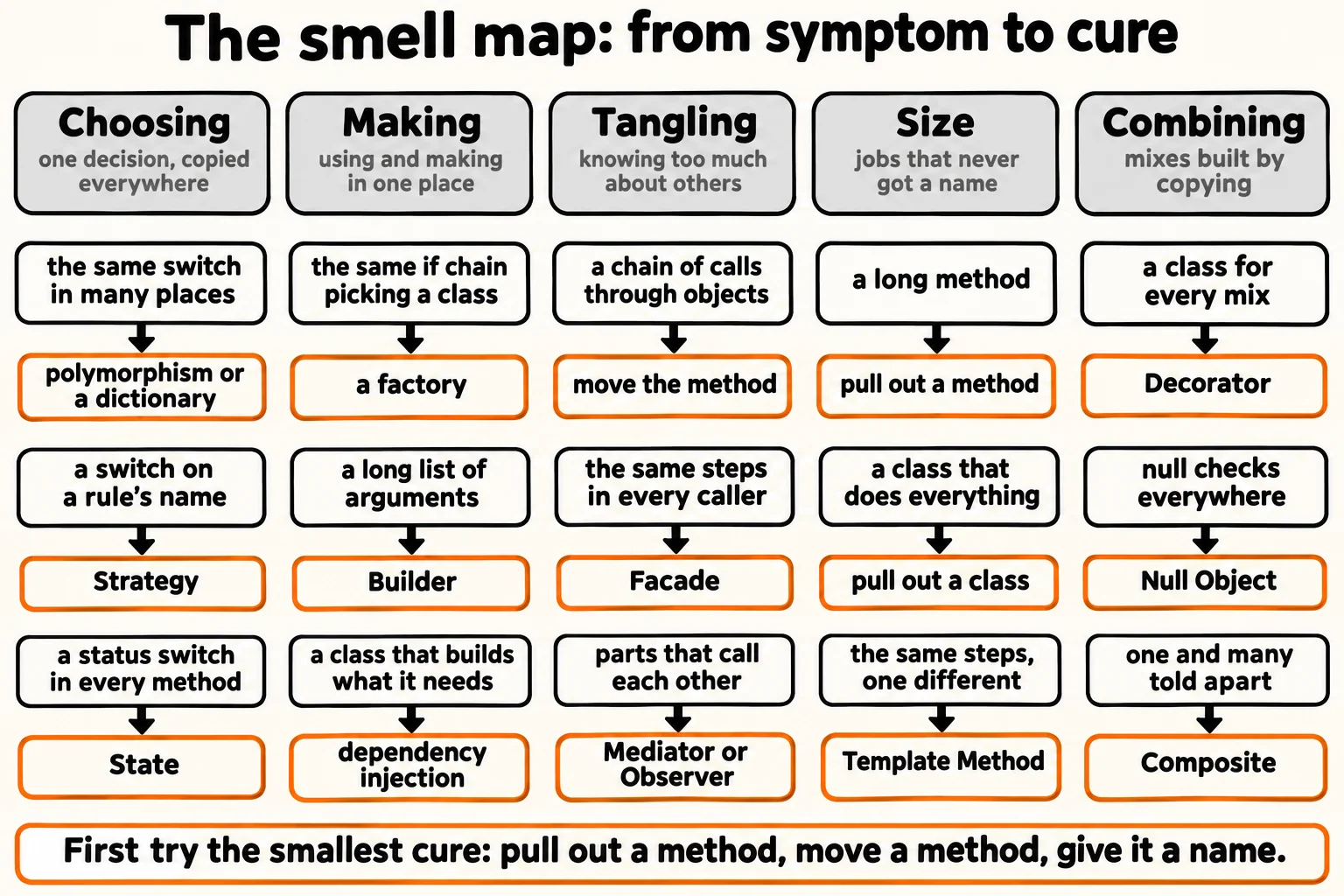
Every pattern lesson in this course began with a smell. Here they all are, by family. Each family has one cause, so if you can name the family, you already know what's wrong underneath. Each lesson is named by the start of its title.
| Smell (the symptom) | Family | Cure | Where you met it |
|---|---|---|---|
The same switch on a kind in many places |
Choosing | Polymorphism, or a dictionary | Smells of Choosing |
A switch on a rule's name, in code that shouldn't change |
Choosing | Strategy | Weekly Deals; Strategy |
A status switch in every method |
Choosing | State | State |
| A true/false argument that changes what a method does | Choosing | Two methods | Smells of Choosing |
| "What kind are you?" checks before acting | Choosing | Polymorphism | Smells of Choosing |
The same if chain that picks a class, in several places |
Making | A factory, or a dictionary of functions | Simple Factory; Factories the Modern Way |
| Two copies of something the whole app must share | Making | One object, made at the start and handed in | Singleton; Why Singleton Is Usually a Trap |
| Tests that pass alone and fail together | Making | Hand in one object; each test makes its own | Why Singleton Is Usually a Trap |
| A class that builds what it needs (its database, the clock) | Making | Dependency injection | Smells of Making; Dependency Injection |
| A constructor with a long list of arguments | Making | Builder, or named arguments | Builder; Builders the Modern Way |
| Rebuilding "the same as last time", field by field | Making | Prototype | Prototype |
| Parts from different families mixed by mistake | Making | Abstract Factory | Abstract Factory |
| Something expensive, made again and again | Making | An object pool, or lazy loading | Object Pool and Lazy Loading |
| A chain of calls that reaches through objects | Tangling | Move the method | Smells of Tangling |
| One small change that touches many files | Tangling | Gather the rule in one place | Smells of Tangling |
| The same steps, in the same order, in every caller | Tangling | Facade | Facade |
| One method that calls everyone who cares, growing with each one | Tangling | Observer | Observer |
| Parts that all call each other | Tangling | Mediator | Mediator |
| Another system's odd calls all through your code | Tangling | Adapter | Adapter |
| Business rules that know how the data is stored | Tangling | Repository | Repository |
| Code that has to know how a collection is stored to walk it | Tangling | Iterator | Iterator |
| An action done by a direct call, which can't be stored or undone | Tangling | Command | Command |
| A new job that means a new method on every class | Tangling | Visitor | Visitor |
| A long method, with comments marking its sections | Size | Pull out a method | Smells of Size |
| A class that does everything | Size | Pull out a class | Smells of Size |
| The same steps, copied with one step different | Size | Template Method, or Strategy | Template Method |
| A long row of checks, each deciding whether to go on | Size | Chain of Responsibility | Chain of Responsibility |
| A page that loads data, shows it and handles clicks | Size | Model, view and controller | MVC |
| Hard-coded rules that the users want to write themselves | Size | Interpreter | Interpreter |
| The same data stored in thousands of objects | Size | Flyweight | Flyweight |
| A class for every combination of features | Combining | Decorator, or a list of extras | Smells of Combining; Decorator |
| A class for every pair of two things that vary | Combining | Bridge | Bridge |
| The same "is it missing?" check before every use | Combining | Null Object | Smells of Combining; Null Object |
| One thing and a group of things, told apart everywhere | Combining | Composite | Composite |
| Extra jobs (a cache, a log, a permission check) pasted around every call | Combining | Decorator, Proxy, or middleware | Decorator; Proxy; Middleware |
| A call to a far-away service with no plan for when it fails | Combining | Retry, and a circuit breaker | Retry; Circuit Breaker |
And the five causes, one per family:
- Choosing: one decision, copied everywhere.
- Making: the code that uses an object also decides how to make it.
- Tangling: code that knows too much about how other objects are put together.
- Size: jobs that never got a name of their own.
- Combining: mixes built by copying, instead of from small parts.
A smell you haven't met
The map doesn't have every smell in the world, and it doesn't need to. Here's one it doesn't list: the gym's reminder texts, which go out the evening before each class:
SendReminders(new List<(string, string, int)> { ("Maya", "Yoga", 7), ("Sam", "Spin", 12), ("Leo", "HIIT", 18) });
void SendReminders(List<(string Name, string Kind, int Hour)> bookings)
{
foreach ((string name, string kind, int hour) in bookings)
{
// Work out the start time as text, such as "7:00 AM" or "6:00 PM".
string suffix = hour < 12 ? "AM" : "PM";
int shown = hour <= 12 ? hour : hour - 12;
string start = Reminder for Maya: Yoga tomorrow at 7:00 AM
Reminder for Sam: Spin tomorrow at 12:00 PM
Reminder for Leo: HIIT tomorrow at 6:00 PM
record Booking(String name, String kind, int hour) {}
void sendReminders(List<Booking> bookings) {
for (Booking booking : bookings) {
// Work out the start time as text, such as "7:00 AM" or "6:00 PM".
String suffix = booking.hour() < 12 ? "AM" : "PM";
int shown = booking.hour() <= 12 ? booking.hour() : booking.hour() - 12;
String start = shown + ":00 " + suffix;
IO.println("Reminder for " + booking.name() + ": " + booking.kind() + " tomorrow at " + start);
}
}
void main() {
sendReminders(List.of(new Booking("Maya", "Yoga", 7), new Booking("Sam", "Spin", 12), new Booking("Leo", "HIIT", 18)));
}
Reminder for Maya: Yoga tomorrow at 7:00 AM
Reminder for Sam: Spin tomorrow at 12:00 PM
Reminder for Leo: HIIT tomorrow at 6:00 PM
def send_reminders(bookings):
for name, kind, hour in bookings:
# Work out the start time as text, such as "7:00 AM" or "6:00 PM".
suffix = "AM" if hour < 12 else "PM"
shown = hour if hour <= 12 else hour - 12
start = f"{shown}:00 {suffix}"
print(f"Reminder for {name}: {kind} tomorrow at {start}")
send_reminders([("Maya", "Yoga", 7), ("Sam", "Spin", 12), ("Leo", "HIIT", 18)])
Reminder for Maya: Yoga tomorrow at 7:00 AM
Reminder for Sam: Spin tomorrow at 12:00 PM
Reminder for Leo: HIIT tomorrow at 6:00 PM
function sendReminders(bookings) {
for (const [name, kind, hour] of bookings) {
// Work out the start time as text, such as "7:00 AM" or "6:00 PM".
const suffix = hour < 12 ? "AM" : "PM";
const shown = hour <= 12 ? hour : hour - 12;
const start = `${shown}:00 ${suffix}`;
console.log(`Reminder for ${name}: ${kind} tomorrow at ${start}`);
}
}
sendReminders([["Maya", "Yoga", 7], ["Sam", "Spin", 12], ["Leo", "HIIT", 18]]);
Reminder for Maya: Yoga tomorrow at 7:00 AM
Reminder for Sam: Spin tomorrow at 12:00 PM
Reminder for Leo: HIIT tomorrow at 6:00 PM
function sendReminders(bookings: [string, string, number][]): void {
for (const [name, kind, hour] of bookings) {
// Work out the start time as text, such as "7:00 AM" or "6:00 PM".
const suffix = hour < 12 ? "AM" : "PM";
const shown = hour <= 12 ? hour : hour - 12;
const start = `${shown}:00 ${suffix}`;
console.log(`Reminder for ${name}: ${kind} tomorrow at ${start}`);
}
}
sendReminders([["Maya", "Yoga", 7], ["Sam", "Spin", 12], ["Leo", "HIIT", 18]]);
Reminder for Maya: Yoga tomorrow at 7:00 AM
Reminder for Sam: Spin tomorrow at 12:00 PM
Reminder for Leo: HIIT tomorrow at 6:00 PM
The owner now wants the weekly schedule to show start times the same way. Something smells, but which smell? Ask three questions, in order:
- What has to change together? The schedule and the reminders must show times the same way. If the format changes (say, to "7 AM"), both must change.
- What decision or job has no home? "Turn an hour into text" is a job, and it has no name: it's three lines in the middle of a loop, with a comment explaining them. That answer places it on the map, in the size family: a job that never got a name.
- Who knows too much? The reminder loop knows how times are formatted, which isn't its job.
The comment is the clue. A comment that explains what the next lines do is the name of a job, waiting to become a method. Books on smells list it as its own smell, comments, and its cure is the plainest one on the map:
SendReminders(new List<(string, string, int)> { ("Maya", "Yoga", 7), ("Sam", "Spin", 12), ("Leo", "HIIT", 18) });
Console.WriteLine(Reminder for Maya: Yoga tomorrow at 7:00 AM
Reminder for Sam: Spin tomorrow at 12:00 PM
Reminder for Leo: HIIT tomorrow at 6:00 PM
Schedule: HIIT at 6:00 PM
record Booking(String name, String kind, int hour) {}
String startText(int hour) {
String suffix = hour < 12 ? "AM" : "PM";
int shown = hour <= 12 ? hour : hour - 12;
return shown + ":00 " + suffix;
}
void sendReminders(List<Booking> bookings) {
for (Booking booking : bookings) {
IO.println("Reminder for " + booking.name() + ": " + booking.kind() + " tomorrow at " + startText(booking.hour()));
}
}
void main() {
sendReminders(List.of(new Booking("Maya", "Yoga", 7), new Booking("Sam", "Spin", 12), new Booking("Leo", "HIIT", 18)));
IO.println("Schedule: HIIT at " + startText(18));
}
Reminder for Maya: Yoga tomorrow at 7:00 AM
Reminder for Sam: Spin tomorrow at 12:00 PM
Reminder for Leo: HIIT tomorrow at 6:00 PM
Schedule: HIIT at 6:00 PM
def start_text(hour):
suffix = "AM" if hour < 12 else "PM"
shown = hour if hour <= 12 else hour - 12
return f"{shown}:00 {suffix}"
def send_reminders(bookings):
for name, kind, hour in bookings:
print(f"Reminder for {name}: {kind} tomorrow at {start_text(hour)}")
send_reminders([("Maya", "Yoga", 7), ("Sam", "Spin", 12), ("Leo", "HIIT", 18)])
print(f"Schedule: HIIT at {start_text(18)}")
Reminder for Maya: Yoga tomorrow at 7:00 AM
Reminder for Sam: Spin tomorrow at 12:00 PM
Reminder for Leo: HIIT tomorrow at 6:00 PM
Schedule: HIIT at 6:00 PM
function startText(hour) {
const suffix = hour < 12 ? "AM" : "PM";
const shown = hour <= 12 ? hour : hour - 12;
return `${shown}:00 ${suffix}`;
}
function sendReminders(bookings) {
for (const [name, kind, hour] of bookings) {
console.log(`Reminder for ${name}: ${kind} tomorrow at ${startText(hour)}`);
}
}
sendReminders([["Maya", "Yoga", 7], ["Sam", "Spin", 12], ["Leo", "HIIT", 18]]);
console.log(`Schedule: HIIT at ${startText(18)}`);
Reminder for Maya: Yoga tomorrow at 7:00 AM
Reminder for Sam: Spin tomorrow at 12:00 PM
Reminder for Leo: HIIT tomorrow at 6:00 PM
Schedule: HIIT at 6:00 PM
function startText(hour: number): string {
const suffix = hour < 12 ? "AM" : "PM";
const shown = hour <= 12 ? hour : hour - 12;
return `${shown}:00 ${suffix}`;
}
function sendReminders(bookings: [string, string, number][]): void {
for (const [name, kind, hour] of bookings) {
console.log(`Reminder for ${name}: ${kind} tomorrow at ${startText(hour)}`);
}
}
sendReminders([["Maya", "Yoga", 7], ["Sam", "Spin", 12], ["Leo", "HIIT", 18]]);
console.log(`Schedule: HIIT at ${startText(18)}`);
Reminder for Maya: Yoga tomorrow at 7:00 AM
Reminder for Sam: Spin tomorrow at 12:00 PM
Reminder for Leo: HIIT tomorrow at 6:00 PM
Schedule: HIIT at 6:00 PM
The reminders print exactly what they did, and the schedule reuses startText instead of copying it. The comment is gone, because the method's name says it. No pattern was needed, and none would have helped.
Why "pull out a method" wins so often
Look down the map's causes again: a decision with no home, a job with no name, knowledge in the wrong place. A method is the smallest home a piece of code can have. So the smallest cures, pull out a method (books call it Extract Method), move a method to the object whose data it uses, and give it a name, cure more smells than all the patterns put together. Changing code's shape without changing what it does, one small step at a time, is called refactoring, and these are its everyday moves.
The patterns aren't a different kind of cure. They're those moves, grown up: a Strategy is a method you can hand in, a Template Method is a method with one step left open, a factory is a method that says new. So the order to try them is:
- The smallest cure first. Pull out, move, rename.
- Then ask about the next requirement. If the gym adds a sixth kind of class next month, will the small cure still hold? If a new kind means editing five places again, it's time for the pattern on the map.
- No cure at all is sometimes right. A
switchin one place, on two kinds that will never change, isn't a smell. It's code.
Check yourself
2 questions to try on the lesson page.
So what
You don't need to have seen a smell before to treat it. Ask what changes together, what has no home and who knows too much, find its family on the map, and try the smallest cure first. Most of the time, that's a method with a good name.