Introduction to Inheritance in C#: an overview
Inheritance lets one class build on another. An archer is a character, so Archer inherits everything Character has, and adds what only archers have.
Apprentice · C# · OOP · Updated
After this lesson you can
- Explain inheritance as an is-a relationship between a base class and a derived class
Key takeaways
- Inheritance fits an is-a relationship: an archer is a character, so
Archercan inherit fromCharacter. - The derived (child) class gets the base (parent) class's properties and methods without writing them again, and adds only its own, such as
Arrows. - Say the sentence out loud. If it's has-a, as in a car has an engine, use a property such as
Engineinstead of inheritance.
Inheritance is one of the pillars of object-oriented programming, beside encapsulation. It solves the problem from DRY Code in C#: shared code written once, with no tangle of ifs.
Is-a
Inheritance describes an is-a relationship. An archer is a character. So the Archer class can inherit from the Character class, and it gets everything Character has: its properties and its methods.
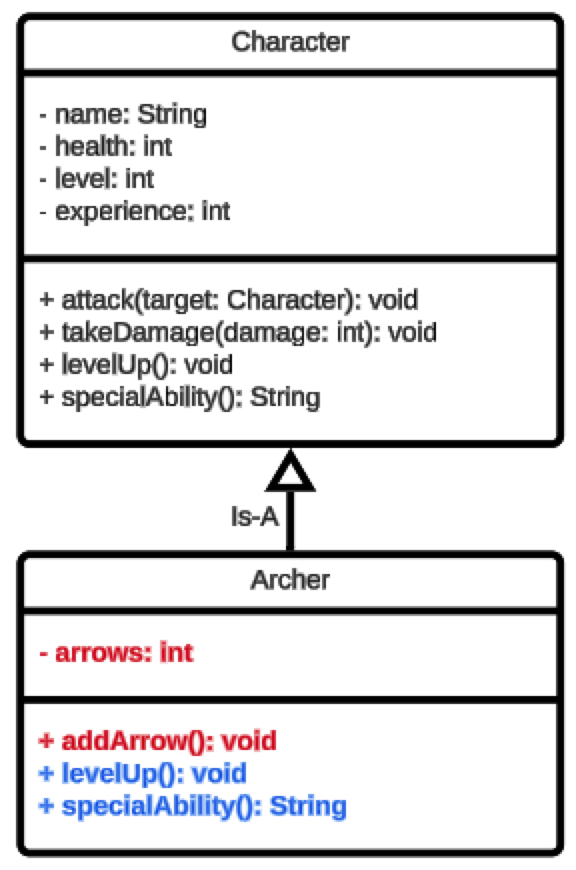
Because an archer is a character, an archer has a name, health, a level and experience, and can attack, take damage and level up, all without writing any of it again. On top of that, Archer adds what only archers have: Arrows, and an AddArrow() method.
The words
| Word | Means | Example |
|---|---|---|
| Base class | The class that's inherited from (also called the parent class) | Character |
| Derived class | The class that inherits (also called the child class) | Archer |
| Inherit | Get the base class's members without writing them again | Archer inherits LevelUp() |
Is-a, or has-a?
Inheritance only fits an is-a relationship. Test it by saying the sentence out loud:
| Sentence | True? | So |
|---|---|---|
| An archer is a character | Yes | Archer can inherit from Character |
| A wizard is a character | Yes | Wizard can inherit from Character |
| An archer is a bow | No: an archer has a bow | Archer gets a Bow property instead |
| A car is an engine | No: a car has an engine | Car gets an Engine property |
When the sentence is has a, the class holds the other as a property: an Order class would hold its products as a List<Product> property. Inheritance is only for is a.
Do it: give the archer a bow
An archer is a character, but an archer has a bow. So Archer doesn't inherit from Bow: it holds a bow, as a property. (Making Archer inherit from Character comes in the next lessons; here, Archer stands on its own.)
The Bow class is given. A bow has two values:
Kind: what kind of bow it is, such as"Longbow".Damage: how much damage its arrows do, such as8.
Your Archer class gets two values when it's made:
name: the archer's name, such as"Robin".bow: the archer's bow, aBowobject.
For example:
Archer robin = new Archer("Robin", new Bow("Longbow", 8));
| You ask for | It gives |
|---|---|
robin.Name |
"Robin" |
robin.Bow.Damage |
8 |
robin.Describe() |
"Robin has a Longbow" |
Your job: write the class Archer.
- A constructor,
Archer(string name, Bow bow). - A
Nameproperty, astring, set fromname. - A
Bowproperty, aBow, set frombow. - A method
Describe()that returns astring: the name, thenhas a, then the bow'sKind.
Until Archer has these, the tests can't run, and the Tests tab names the first thing they're missing.
Practiced live on the lesson page: write the C# right there and check it.
Check yourself
1 question to try on the lesson page.
So what
Inheritance turns "an archer is a character" into code: one base class with the shared parts, and a derived class for each kind with only its own parts. The next lessons show how to find those parts and write them in C#.