Model Review
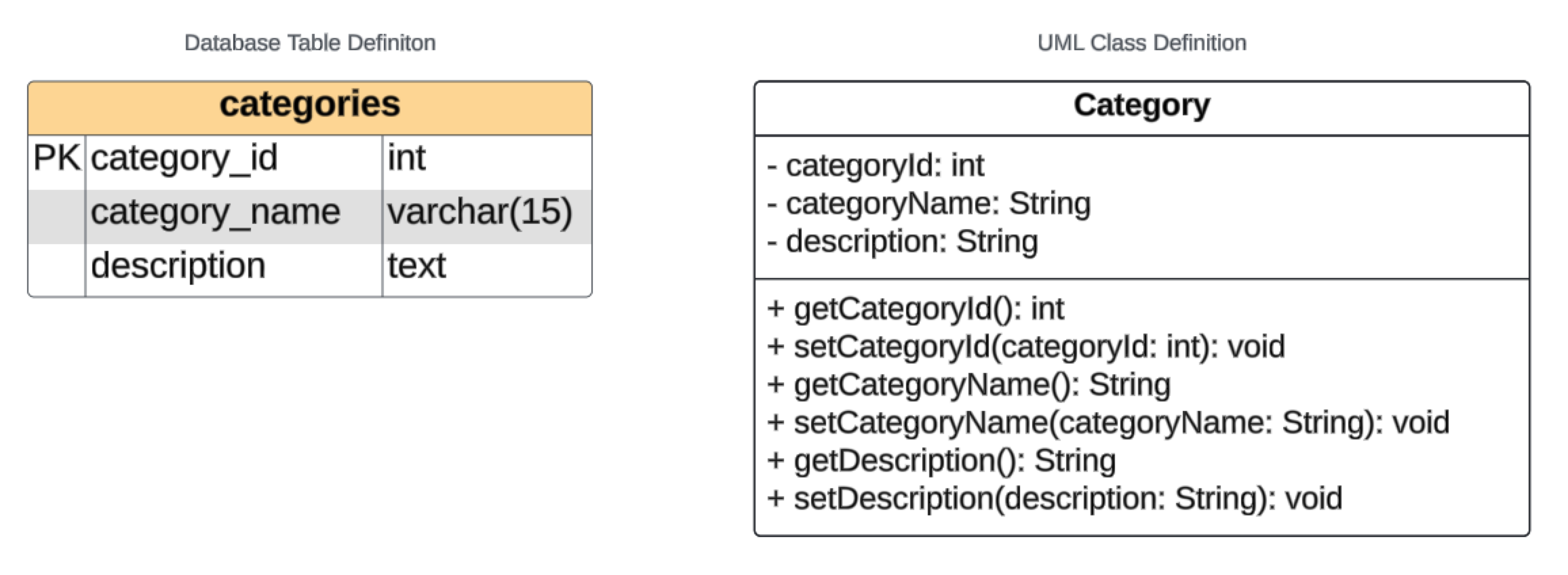
A Category model class has a private field, a getter and a setter for each column of the categories table.
Journeyman · Java · SQL · Updated
In Creating Data Models, in the Encapsulation chapter, we created a class for a Category model. This model matches the data that is stored in each row of the categories table.
Example
public class Category
{
    private int categoryId;
    private String categoryName;
    private String description;

    public int getCategoryId()
    {
        return categoryId;
    }
    public void setCategoryId(int categoryId)
    {
        this.categoryId = categoryId;
    }

    public String getCategoryName()
    {
        return categoryName;
    }
    public void setCategoryName(String categoryName)
    {
        this.categoryName= categoryName;
    }

    public String getDescription()
    {
        return description;
    }
    public void setDescription(String description)
    {
        this.description= description;
    }

}
Do it: write the Product model
The products page needs Northwind's products as Java objects, so it needs a model for the products table, the way Category models categories. Here are the columns it uses, and the variable each one becomes. A whole-number column is an int, text is a String, and a price with decimal places is a double:
| Column | SQL type | Variable in the model |
|---|---|---|
product_id |
int |
productId, an int |
product_name |
varchar(40) |
productName, a String |
unit_price |
decimal(10,4) |
unitPrice, a double |
units_in_stock |
smallint |
unitsInStock, an int |
For example, Chai's row is 1, Chai, 18.00, 39. Its object is filled like this:
Product product = new Product();
product.setProductId(1);
product.setProductName("Chai");
product.setUnitPrice(18.0);
product.setUnitsInStock(39);
After those four calls, the getters give back 1, "Chai", 18.0 and 39.
Your job: finish the class Product. Its getters and setters are there, with empty bodies.
- Add a private variable for each column, with the name and type in the table.
- Each getter returns its variable.
- Each setter copies its parameter into its variable.
- Each product keeps its own values: setting one doesn't change another.
Practiced live on the lesson page: write the Java right there and check it.