Nullable Value Types
Store "no value yet" in an int?, decimal? or bool?, check it with HasValue or null before you read it, and write an optional parameter that a call can leave out.
Apprentice · C# · Updated
After this lesson you can
- Store a missing value in a nullable value type such as int?, and check it with HasValue or null before reading it
- Write a method with an optional parameter, such as int? points = null, that a call can leave out
Key takeaways
- An
intalways holds a number, so 0 can't mean "no value yet". Anint?holds a number ornull, which means no value at all. - The
?works the same way ondecimal,doubleandbool. Abool?has three states, such as yes, no and "hasn't answered yet". - Check before you read.
HasValueand!= nullaretruewhen there's a number, and.Valuereads it;.Valueonnullstops the program. - A parameter with a default value, such as
int? points = null, is optional. A call can leave it out, and the method gets the default. - Optional parameters come after the required ones.
Real data has gaps. A game that hasn't been played has no score yet. A sign-up form has fields people leave blank. A product can be waiting for its price. Your programs need a way to say "there's no value here yet" that can't be mistaken for a real value. You'll use it in nearly every app that reads a form, and in every app that reads a database: later in the course, a database column that may be empty comes back to C# as exactly the kind of type this lesson teaches.
Zero isn't "no score yet"
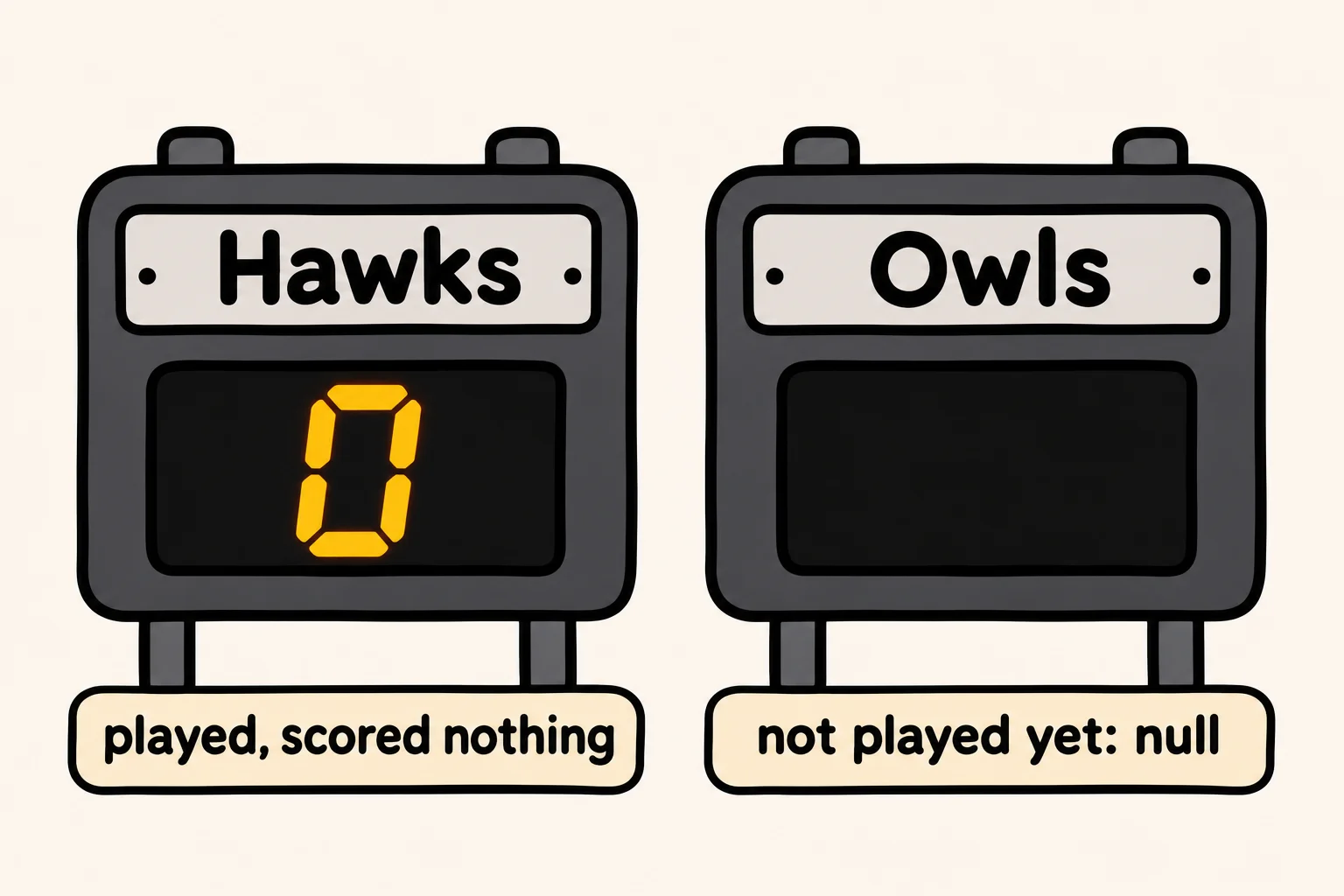
The backyard basketball league keeps every team's points on its website. On Saturday morning, the Hawks have played their game and scored nothing (a bad day), and the Owls haven't played yet. An int has to hold a number, so both get a 0:
int hawksPoints = 0;   // played, and scored nothing
int owlsPoints = 0;    // hasn't played yet
Anyone reading the website sees two teams with 0 points. One of those numbers is a lie.
A common first fix is a "magic number" that means "not played": -1, say. It works until some code forgets about it. Here a season total adds up the Hawks' games, and the third game hasn't been played:
int[] hawksSeason = { 42, 38, -1 }; // -1 means "not played yet"
int total = 0;
foreach (int points in hawksSeason)
{
total += points;
}
Console.WriteLine(Season points: 79
The Hawks scored 80 points, not 79. Every piece of code that ever touches the scores has to remember the -1, and one that doesn't gives a wrong answer with no error to warn you.
What the league needs is what a real scoreboard does before the game starts: it's blank. A blank says "nothing here yet"; a 0 says "we counted, and it came to nothing". C# has a word for the blank, null, which means no value at all. You met it in Understanding the String Class. But an int can't hold it:
int owlsPoints = null;
error CS0037: Cannot convert null to 'int' because it is a non-nullable value type
int?: a number, or nothing
Put a ? after the type, and the variable can hold either a number or null. int? is read "nullable int", and it's called a nullable value type:
int? hawksPoints = 0; // played, and scored nothing
int? owlsPoints = null; // hasn't played yet
Console.WriteLine(Hawks: 0
Owls:
False
True
- A
nullprints as nothing at all, which is why the Owls' line ends after the colon. == nullasks "is there no value?", and!= nullasks "is there a value?". The Hawks' 0 is a real value, sohawksPoints == nullisFalse.
The ? works the same way on decimal, double and bool. A bool? is handy for a question someone hasn't answered yet, because it has three states: true, false and null.
decimal? ticketPrice = null;     // the league hasn't set a price yet
bool? mayaPlaysSaturday = null;  // Maya hasn't answered yet

Console.WriteLine(ticketPrice == null);
Console.WriteLine(mayaPlaysSaturday == null);

mayaPlaysSaturday = false;       // now she has: she can't make it
Console.WriteLine(mayaPlaysSaturday == null);
Console.WriteLine(mayaPlaysSaturday);
True
True
False
False
Maya's false is an answer ("no, I can't play"), and null is no answer at all. A plain bool couldn't tell the two apart.
Check before you read: HasValue and .Value
A nullable value type has two properties for getting at what's inside:
HasValueistruewhen there's a number andfalsewhen it'snull. It means the same as!= null..Valuegives you the number itself, as a plainint.
You need .Value because an int? might be empty, and C# won't let you put a maybe-empty value where an int must go:
int? owlsPoints = null;
int total = owlsPoints;
error CS0266: Cannot implicitly convert type 'int?' to 'int'. An explicit conversion exists (are you missing a cast?)
So check first, then read. Here's the season total again, with null for the game that hasn't been played:
int?[] hawksSeason = { 42, 38, null };
int total = 0;
int played = 0;
foreach (int? points in hawksSeason)
{
if (points.HasValue)
{
total += points.Value;
played++;
}
}
Console.WriteLine(2 games played, 80 points
int?[] is an array of nullable ints, so each game holds a score or null. Inside the if, points is sure to have a number, so points.Value is safe. if (points != null) would do the same job.
Reading .Value without checking works only while there's a value. On null, the program stops:
int? owlsPoints = null;
Console.WriteLine(owlsPoints.Value);
Unhandled exception. System.InvalidOperationException: Nullable object must have a value.
Optional parameters: a call can leave it out
The league's website shows a line for each team. After the game, the method gets the team and its points. Before the game, there are no points to pass. You could write two methods, but there's a neater way: give the parameter a default value, the value it gets when a call leaves it out. A parameter with a default value is an optional parameter.
Start with a default that's a plain value. A new player who isn't on a team yet goes on the waitlist:
Console.WriteLine(Welcome("Maya"));
Console.WriteLine(Welcome("Leo", "Hawks"));
string Welcome(string name, string team = "the waitlist")
{
return Welcome, Maya! You're on the waitlist.
Welcome, Leo! You're on Hawks.
Now the score line. Its default is null, so the method can tell "the call left the points out" from "the team scored 0":
Console.WriteLine(ScoreLine("Hawks", 42));
Console.WriteLine(ScoreLine("Owls", 0));
Console.WriteLine(ScoreLine("Bears"));
string ScoreLine(string team, int? points = null)
{
if (points == null)
{
return Hawks: 42 points
Owls: 0 points
Bears: not played yet
int? points = nullreads "points, a nullable int, which isnullwhen the call leaves it out".ScoreLine("Bears")leaves the points out, sopointsisnull.- A plain
int points = 0would also make the parameter optional, but thenScoreLine("Bears")andScoreLine("Owls", 0)would look the same to the method.nullkeeps them apart. - Optional parameters come after the required ones. Put
int? points = nullfirst, and C# stops witherror CS1737: Optional parameters must appear after all required parameters.
Do it: find a player's best game
The league's stats page shows each player's best game of the season: the most points they scored in one game. Games that haven't been played yet are null, and they must not count.
The method gets one value:
games: the player's points in each game of the season, anint?[]. A game not played yet isnull({ 12, null, 20, 7 }).
For example, with { 12, null, 20, 7 }:
| Game | Points | Best so far |
|---|---|---|
| 1 | 12 | 12 |
| 2 | null: not played, skip it |
12 |
| 3 | 20 | 20 |
| 4 | 7 | 20 |
So BestGame(new int?[] { 12, null, 20, 7 }) returns 20.
Your job: write the method int? BestGame(int?[] games).
- Return the most points in one played game.
- Skip every game that is
null. - When no game has been played (every game is
null, or the array is empty), returnnull. - A game of 0 points is a real game:
{ 0, null }returns0, notnull.
Practiced live on the lesson page: write the C# right there and check it.
Check yourself
2 questions to try on the lesson page.
So what
null is how a program says "there's nothing here yet", and an int? lets a number say it too, so a blank never gets mistaken for a 0 again.